


Your Team Isn’t Actually a Team
In today’s email:
- Why your financial team probably isn’t acting like one — and what falls through the gap
- The RRSP deadline is one week away — and why the right contribution amount isn’t always obvious
- Markets hit a record high in Canada, the U.S. Supreme Court made a call that mattered, and we’ve got a big week ahead for Canadian bank earnings
- What coordinated financial planning actually looks like — and a simple ask
Beyond the Portfolio
A quick reminder: the RRSP contribution deadline is March 2nd — one week away.
If you’re still deciding how much to contribute, or whether it makes sense to contribute at all this year, that’s worth a conversation before the deadline. The right answer depends on your income, your tax situation, and what’s already happened in your portfolio this year — which is exactly the kind of thing we’d rather work through together now than flag in April.
The Scoop
Everyone’s Doing Their Job. Nobody’s Connecting the Pieces.
Right now, somewhere in a file on your accountant’s desk, there’s a number that affects your investment strategy. Your investment advisor doesn’t know about it.

And somewhere in the work your investment advisor has been doing on your portfolio, there are decisions — contributions, withdrawals, asset mix changes — that will show up on your tax return in April. Your accountant won’t know about them until it’s too late.
This isn’t anyone’s fault. It’s just how the system is built. Your accountant does their job. Your investment advisor does theirs. They’re both competent. They’re both working in your interest. But they’re not working together — and in the gap between them, things get missed.
It happens in small ways and large ones. A capital gain triggered without flagging the tax hit. RRSP contribution room used in the wrong year. A business income spike that should have changed what a withdrawal looked like. Or something as simple as one side not knowing the other changed something — so the plan gets built on stale information.
Most clients only discover the gap when they get a tax bill they weren’t expecting, or when they realize the two conversations have been running in parallel for years with nobody connecting them.

Coordinated looks like this: your accountant knows what happened in your portfolio before they start your return. Your investment strategy accounts for your full income picture, not just what the market did. When something changes on one side, the other side hears about it. It sounds simple. It’s rarer than you’d think.
With the RRSP deadline a week away and tax season officially underway, this is exactly the time of year when the gap between your advisors either costs you something or doesn’t. A last-minute contribution sounds straightforward — but the right amount, and whether it even makes sense this year, depends on conversations that may not have happened yet.
If we haven’t already connected with your accountant, we’d love the introduction. A quick email — “these two should know each other” — is all it takes. In our experience, accountants appreciate knowing there’s a financial planner in the picture who thinks this way. And for you, it means one less thing falling through the cracks.
Market Minute
Week Ending February 21, 2026
This was a week where a single court ruling did more for Canadian markets than months of diplomacy had managed to. The U.S. Supreme Court struck down the sweeping tariff package on Friday, and the reaction was immediate — particularly here at home. The tariff overhang has been one of the most persistent sources of uncertainty for Canadian investors since the start of the year, and while legal battles rarely resolve anything cleanly, the ruling gave markets something they’d been missing: a reason to exhale.
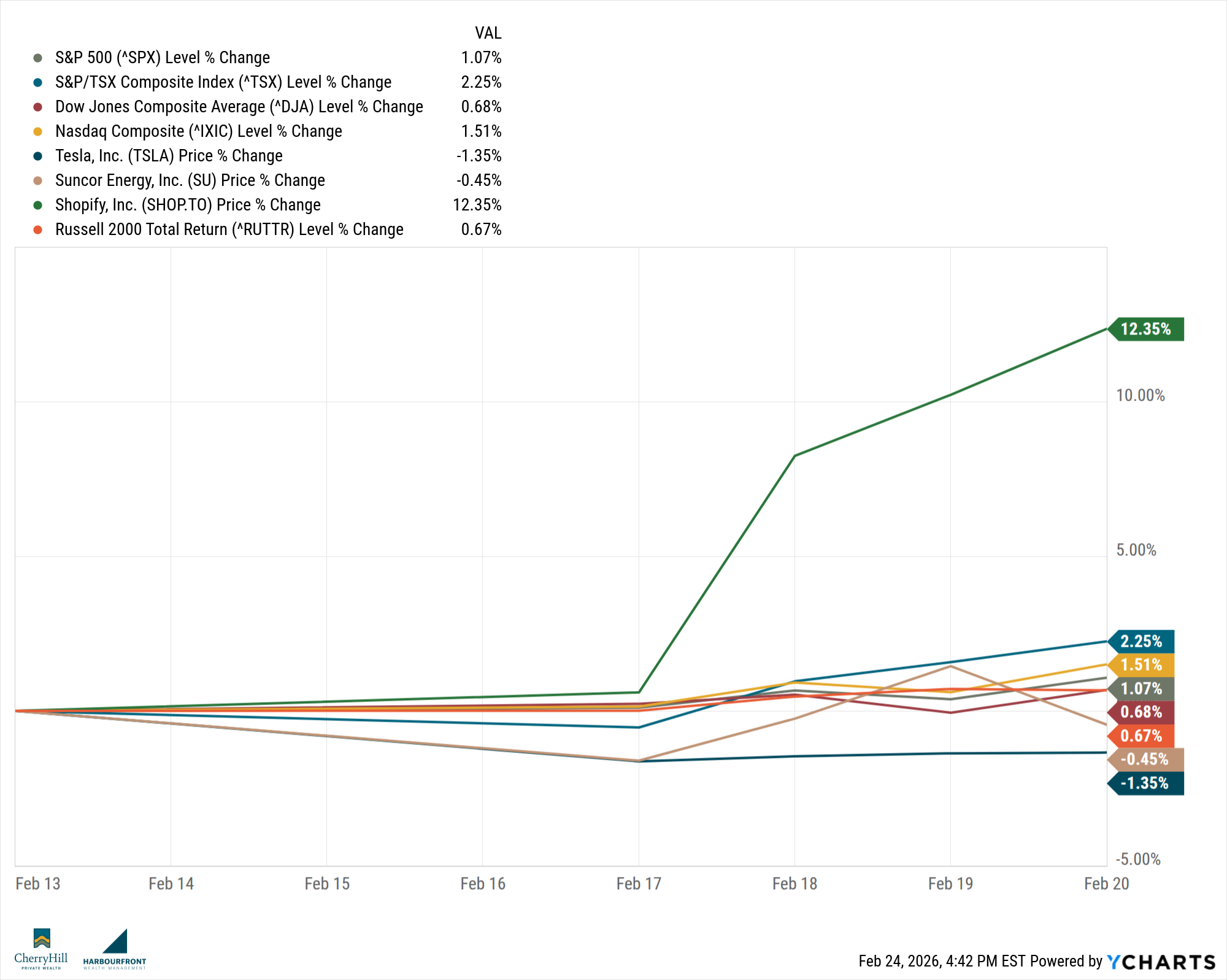
Canadian Markets:
TSX: 33,820 (+3.9% on the week, +6.0% YTD)
The TSX hit an all-time high this week, and it wasn’t by accident. Canada’s index has been quietly outperforming most global peers since January, carried by two engines that don’t usually run in sync: gold and financials. Gold’s relentless push toward $3,000/oz has lifted the materials sector in a way that’s actually reshaping the composition of the index — gold stocks have now surpassed energy stocks in total market cap on the TSX for the first time on record. That’s not a footnote. That’s a structural shift worth paying attention to.
U.S. Markets:
S&P 500: 6,909 (+0.7% on the week, roughly flat YTD)
The U.S. market ended the week on a positive note, but the broader story is an index that’s been range-bound since January. The Mag-7 tailwind that carried markets for two years has largely stalled, while energy, industrials, and materials have picked up the slack. Corporate earnings have actually been strong — Q4 blended growth came in around 13%, with 75% of companies beating estimates. The market isn’t being held back by fundamentals. It’s being held back by valuation concerns and policy uncertainty. That combination tends to reward patient investors more than reactive ones.
Global Markets:
MSCI EAFE: ~7.8% YTD)
International developed markets continue to be the quiet winner of 2026. While the S&P 500 has gone essentially nowhere year-to-date, Europe, Australia, and Japan are up nearly 8%. Some of it is valuation catch-up — international stocks entered the year at a meaningful discount to U.S. equities. Some of it is currency. And some of it is simply diversification doing what it’s supposed to do: showing up when one market stalls.
Sector Spotlight: Gold — Signal or Speculation?
Gold is testing $3,000/oz after a sustained run driven by geopolitical risk, rising sovereign debt, and ongoing central bank buying. The structural case for holding gold as a portfolio diversifier remains intact. The short-term case for chasing it at these levels is a different conversation — moves like this can also mean the easy money has already been made. What it does reinforce is why small, thoughtful positions in assets that don’t move with equities can matter — especially when markets get unsettled.
Quote of the Week:
“The investor’s chief problem — and even his worst enemy — is likely to be himself.”
— Benjamin Graham
Trends to Watch This Week:
Canadian bank earnings arrive in a compressed window this week — BMO, RBC, CIBC, Scotiabank, National, and TD all report between February 24–26. With financials representing roughly 30% of the TSX, this matters. Any follow-through on the tariff ruling in Washington. And whether the value-over-growth rotation that’s defined 2026 so far has staying power as rate expectations continue to shift.
The Bigger Picture
Markets did what they usually do: reacted to the headline, then zoomed out. The tariff ruling was the catalyst, but the underlying conditions — strong earnings, broader sector participation, and steady international momentum — were already in place. Canada’s record high this week isn’t just a number. It reflects a market that’s been quietly building on solid ground while the noise stayed loud. If that continues, the playbook stays the same: stay diversified, don’t overtrade the headlines, and make sure your portfolio doesn’t rely on one perfect outcome to hold up.
Final Thought
Tax season has a way of exposing what’s actually connected in your financial life — and what isn’t.
The RRSP deadline, the tax slips, the conversations with your accountant — these feel like annual logistics. And they are. But they’re also a window into something more important: whether the people managing different parts of your financial life are actually working from the same picture.
Most of the time, they’re not. Not because anyone is doing a bad job — but because coordination doesn’t happen automatically. Someone has to own it.
That’s the role we play for our clients. Not just managing the portfolio, but making sure the portfolio connects to the tax strategy, the income plan, the estate considerations, and the decisions that are coming up next. When it works, clients stop getting surprised. They stop being the ones holding all the pieces together.
If this tax season is feeling like another year of managing everything yourself — fielding calls from your accountant, forwarding documents, trying to remember what changed — that’s worth addressing. Not just this year. For good.
Until next time, stay informed and strategically invested!
Trevor