


The Team Behind the Team
In today’s email:
- The Winter Olympics just kicked off — and there’s a financial planning lesson hiding in plain sight
- Markets had a wild week: the Dow hit 50,000 for the first time, tech stocks took a beating, and Canada’s unemployment surprised to the downside
- RRSP season reminder — your March 3rd deadline is getting closer
- A quick note on some changes coming to this newsletter
Beyond the Portfolio
RRSP Deadline: Less Than a Month Away
March 3, 2026 is the deadline to contribute to your RRSP for the 2025 tax year. If you haven’t already, now’s a good time to confirm your contribution room and make a plan. And if you’re weighing RRSP vs. TFSA vs. paying down debt — that’s exactly the kind of conversation we have with clients every day. Don’t guess. Get it right for your situation.
The Scoop
The Winter Olympics kicked off in Milan and Cortina d’Ampezzo last Thursday, and if you’re anything like us, you’ve already been pulled in. Whether you’re watching from the couch after a long day or catching highlights between meetings, there’s something about the Winter Games that hits different.
But here’s the thing that always strikes me when I watch the Olympics.

When Mikaël Kingsbury drops into a moguls run — and this is likely his last Olympics after 100 World Cup wins, a gold medal, two silvers, and carrying the Canadian flag at the opening ceremony — he’s the one on the screen. He’s the one getting the score. But behind that sixty-second run is an entire operation most people never see. Coaches analyzing every bump. Equipment techs tuning skis to the specific snow conditions that morning. Physiotherapists managing a body that’s been pushed to its limits for over fifteen years. Sport psychologists. Data analysts. A travel and logistics team coordinating across four different venues in two different cities — because this is the first Olympics in history to be officially co-hosted by two cities, which required an entirely new level of coordination just to make the event work.
The athlete performs. But the performance only happens because there’s a coordinated team working behind the scenes — and someone making sure all those people are actually talking to each other.
Now think about your own situation for a second.

You’ve built something — a business, a career, a family. You’ve got real assets and probably some real complexity in your financial life. You’ve got professionals around you — an accountant, a lawyer, maybe an insurance advisor and someone managing your investments. All good people. All focused on their own discipline.
But who’s coordinating them?
If you’re being honest, the answer might be you. You’re the one relaying information between professionals who’ve never met each other. Making sure the estate plan lines up with the insurance. Wondering if the tax strategy actually reflects what’s happening in the portfolio. Holding it all together with phone calls and good intentions.
That’s like asking an Olympic athlete to also be their own coach, equipment tech, nutritionist, and logistics coordinator — all while trying to perform at the highest level. It doesn’t work that way in sport. It shouldn’t work that way in your financial life either.
This is something we’ve been building toward at Cherry Hill for a while now — and it’s becoming the core of what we do. We make sure the people and the strategies around your financial life are all working from the same playbook. We’re the ones picking up the phone, connecting the dots, and making sure nothing falls through the cracks. Sometimes that means bringing capabilities in-house so the coordination is tighter. Sometimes it means working more closely with the professionals you already have. Either way, someone is quarterbacking the whole picture — not just managing one piece of it.
The clients who tell us they feel the most confident aren’t necessarily the ones with the most money. They’re the ones who finally have that coordination in place — so they’re not the one holding it all together anymore.
The Olympics will run through February 22nd. Enjoy watching the best in the world do what they do. And if it makes you think about whether your own team is as coordinated as it could be — that might be worth paying attention to.
Market Minute
Week Ending February 6, 2026
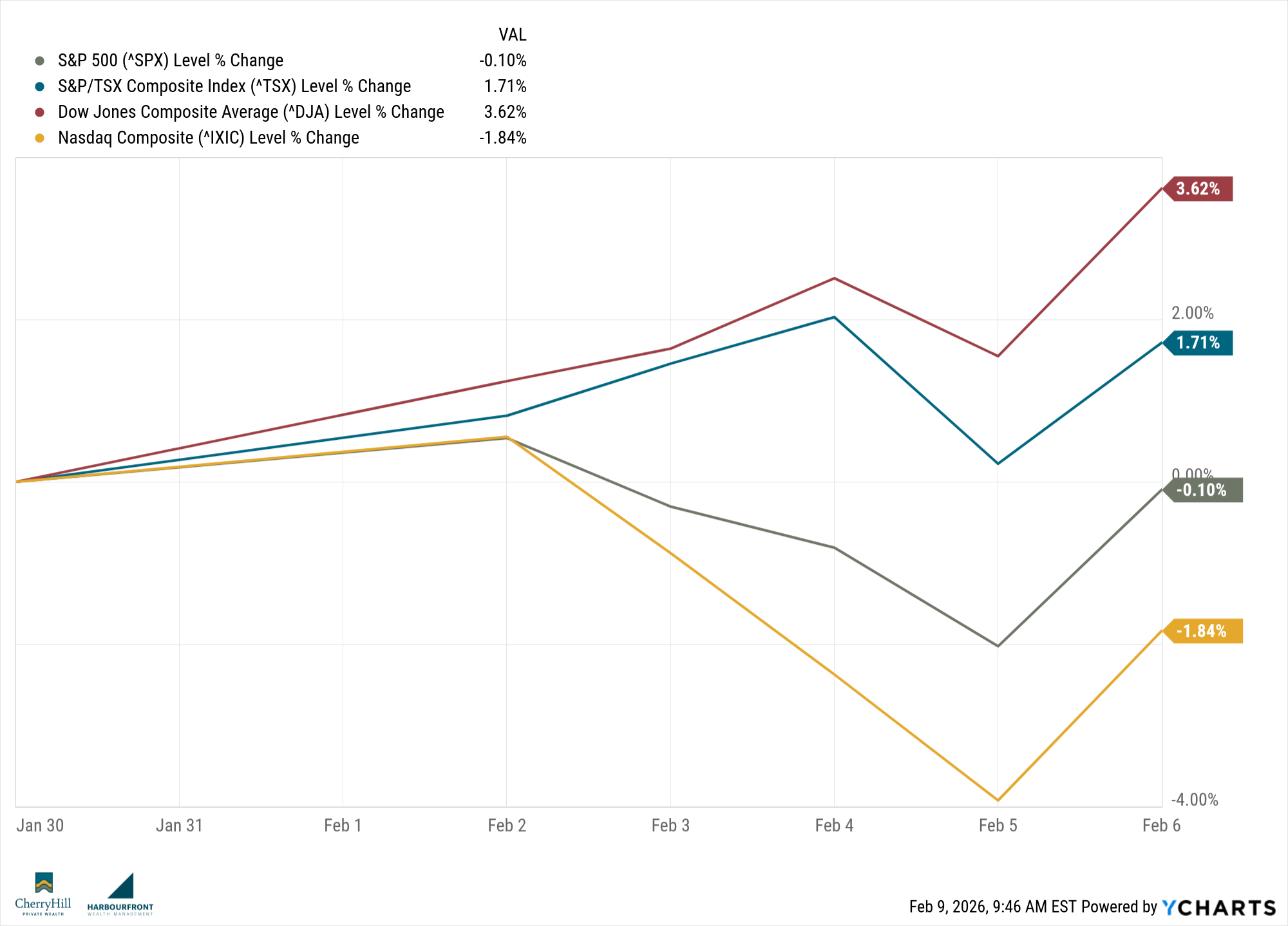
This was one of those weeks where the day-to-day felt chaotic, but the weekly numbers tell a much calmer story than it felt living through it. Tech stocks got hammered mid-week on fears that AI is about to disrupt established software companies — and then Friday saw one of the sharpest rebounds of the year. The real story wasn’t the sell-off or the bounce. It was what happened underneath: money quietly rotating out of the biggest tech names and into sectors that hadn’t led in years.
Canadian Markets:
TSX: 32,471 (+1.7% on the week, +2.4% YTD)
Canada had a genuinely strong week, and the catalyst was a jobs report that caught most people off guard. Unemployment dropped to 6.5% in January — better than expected and a sign that the labour market is holding up despite all the uncertainty around trade.
Tech and mining stocks led the way. Gold miners got a nice lift from gold prices jumping nearly 3% on the week, while energy was more mixed with oil prices swinging ahead of U.S.-Iran talks. The TSX continues to benefit from the rotation theme — when investors look for alternatives to U.S. mega-cap tech, Canada’s resource-heavy index suddenly looks a lot more interesting.
U.S. Markets:
S&P 500: 6,932 (-0.1% on the week, +1.3% YTD)
The S&P 500 was essentially flat for the week — which completely masks how wild the ride was getting there.
The headline moment was the Dow crossing 50,000 for the first time on Friday, closing at 50,116 after surging over 1,200 points in a single session. For the week, the Dow was up about 2.5%. But the Nasdaq told a different story, falling 1.8% as software stocks bore the brunt of AI disruption fears. Amazon didn’t help, reaffirming plans to spend $200 billion on AI infrastructure — the kind of number that makes investors ask whether the returns will ever match the investment.
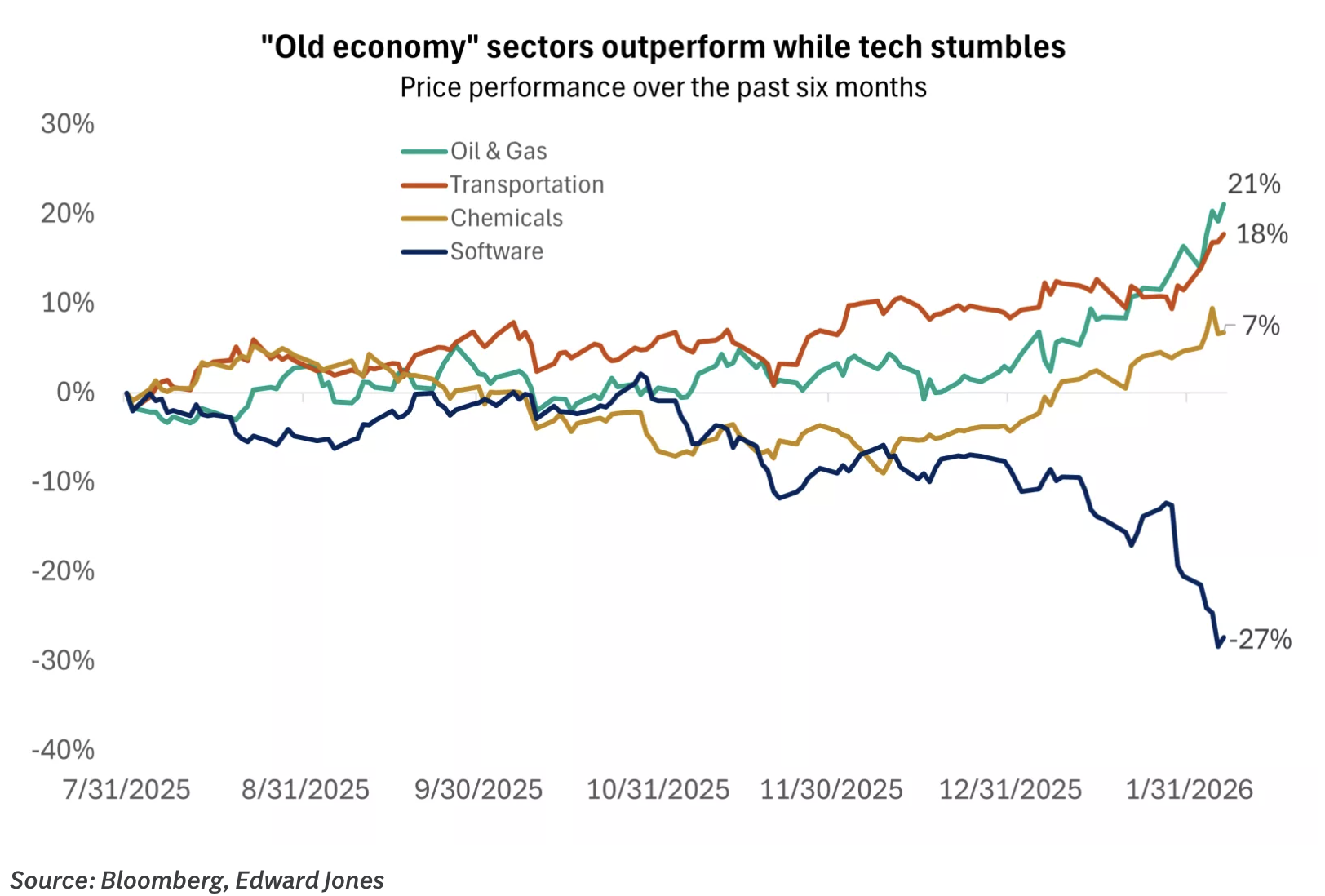
What stood out to me wasn’t the sell-off itself — it was where the money went. Industrials, financials, cyclicals, consumer staples — the “old economy” names that had been sitting quietly for years all had a strong week. That kind of rotation is actually healthy. It means the market is broadening out rather than depending on the same handful of names for all its returns.
Global Markets:
MSCI EAFE: 3,029 (-0.5% on the week, +4.7% YTD)
International developed markets pulled back slightly, but the YTD story is worth noting — up almost 5% while the S&P 500 is up just over 1%. Part of that is valuation (international stocks were simply cheaper coming into the year), and part of it is the same rotation we’re seeing in North America. When leadership broadens, diversification starts doing what it’s supposed to do.
Sector Spotlight: The Rotation Is the Story
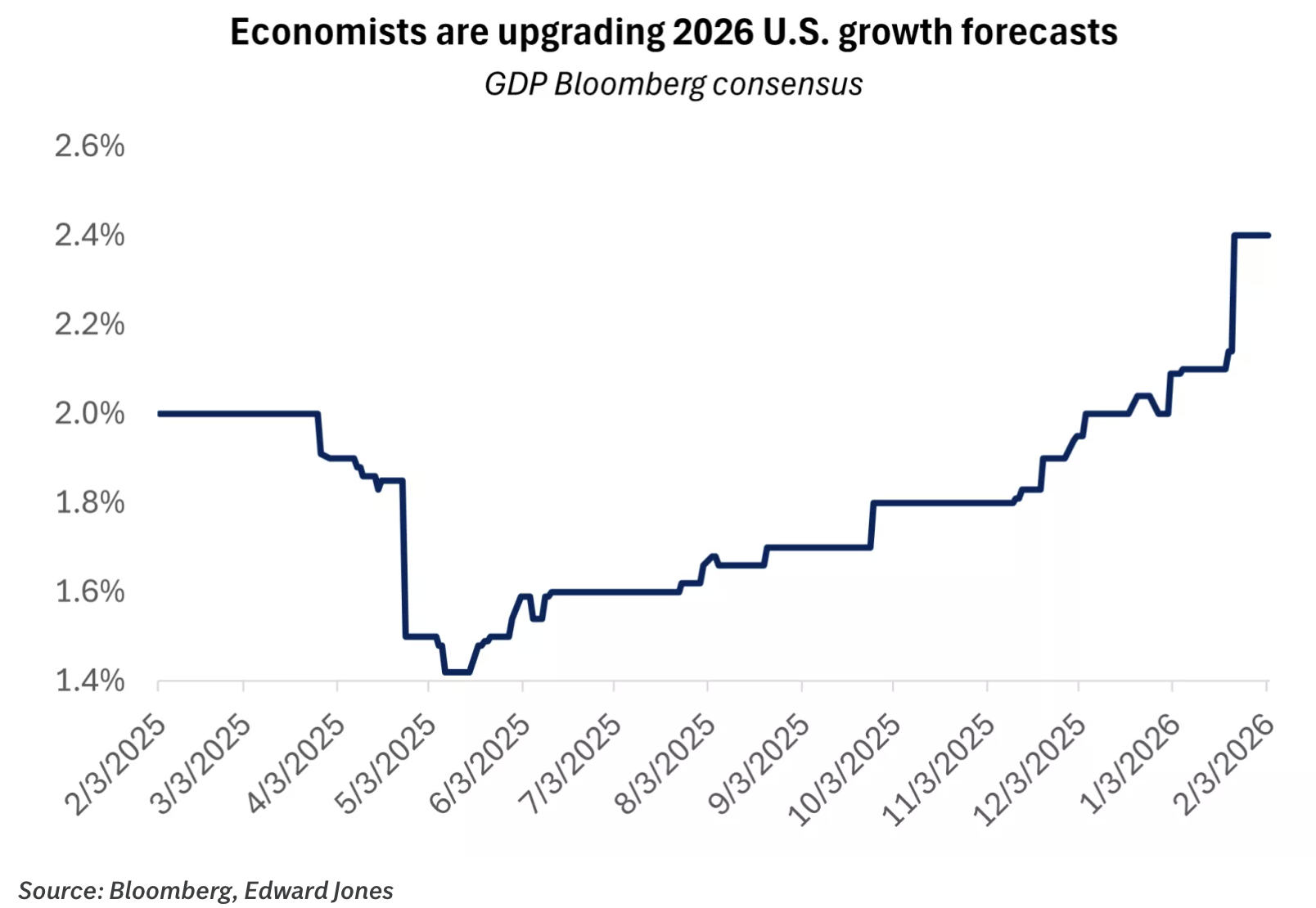
The most important thing that happened this week wasn’t the Dow hitting a milestone or the tech sell-off. It was the confirmation that market leadership is shifting. Energy, industrials, materials, financials — sectors that had been afterthoughts during the AI-driven rally — are now leading. U.S. manufacturing activity hit its strongest level since 2022.
This doesn’t mean tech is dead. It means the market is getting healthier. And for diversified portfolios — especially ones with exposure to private markets, real assets, and non-correlated strategies — this is exactly the kind of environment where the approach pays off. The tech sell-off didn’t touch private credit. The rotation didn’t disrupt the underlying plan. That’s not luck. That’s design.
Quote of the Week:
“The way a team plays as a whole determines its success. You may have the greatest bunch of individual stars in the world, but if they don’t play together, the club won’t be worth a dime.”
— Babe Ruth
Trends to Watch This Week:
Here’s what we’re keeping an eye on this week.
- U.S. inflation data (CPI): This will set the tone for the Fed’s March meeting. Markets are currently pricing almost no chance of a rate cut before May — sticky inflation would reinforce that, while a downside surprise could change the conversation.
- U.S. retail sales and jobs data: After last week’s uptick in jobless claims (partly weather-related), markets will be watching for whether the labour market is cooling gradually or showing real cracks.
- CUSMA watch: The upcoming review of the Canada-U.S.-Mexico trade agreement remains the single biggest wildcard for the Canadian economy in 2026. No major developments expected this week, but it’s the background hum to everything we’re watching north of the border.
Final Thought
Quick note on this newsletter.
We’ve been putting these out weekly for a while now, and it’s been great. But I’ve been thinking about how to make each one more valuable rather than just more frequent. Starting later this month, Cherry Hill Weekly is moving to an every-other-week cadence. Same format, same content — just with more room to make each issue worth your time.
On the off-weeks, we’re launching something new: a shorter, more personal letter written specifically for founders and business owners navigating the financial complexity that comes with building something real. Different format. One idea per issue. More direct, more personal.
If that sounds like you — or someone you know — keep an eye out. We’ll share the sign-up link in the next issue.
Same commitment to keeping you informed. Just a smarter way of doing it.
As always, if anything in this email sparked a question or you want to talk through how any of this applies to your situation, just reply. We read every one.
Until next time, stay informed and strategically invested!
Trevor