


They Get it Wrong 83% of the Time — But You’re Still on the Hook
In today’s email:
- A championship reminder: minimize mistakes, protect the lead
- Is the U.S. economy slowing — or just being misunderstood?
- When the CRA gives bad advice — and you’re still on the hook
- $166 million in TFSA penalties? It’s more common than you think
- What to ask every time you call the CRA
- A quote worth remembering in uncertain times
Beyond the Portfolio
This week, I sat down with Dave Wahl, Director and Senior Client Portfolio Specialist at ClearBridge Investments, to discuss one of the most common questions I’ve been hearing lately — are we actually heading into a recession, or is the economy still expanding?
Dave walked me through ClearBridge’s Recession Risk Dashboard, a framework used by institutional investors to gauge the health of the U.S. economy. We covered everything from tariffs and labour data to investor behaviour and market concentration — and why the data might be telling a different story than the headlines.
You can watch the full conversation here — Are We Headed for a Recession?
The Scoop
Most Canadians assume that calling the Canada Revenue Agency (CRA) or checking their website is the safest way to get tax answers. After all, it’s their system — they should know how it works, right?
But what happens when they get it wrong?
A recent National Post article reminded us just how often this happens. It turns out that CRA call centre agents are evaluated primarily on how quickly they get you off the phone — not whether the information they give is accurate. In fact, a recent federal audit found that agents gave correct answers to individual tax questions only 17% of the time.
That means four out of five times, the information you’re getting may be incomplete or flat-out wrong.

Real Mistakes, Real Consequences
Here are a couple of real-world examples that show how costly it can be when bad advice comes from the very institutions meant to help us:
- Case A: A B.C. taxpayer received an amended T4A from their employer, but the CRA mistakenly added the original and amended amounts together — doubling his reported income. Even though the Tax Court acknowledged the CRA’s mistake and called it “stupid,” the taxpayer had missed the deadline to object. He’s still on the hook for thousands in taxes he doesn’t actually owe.
- Case B: In several other rulings, the Tax Court has made one thing clear: even if you follow advice from a CRA agent, you’re still responsible for the outcome. The CRA’s own interpretations of tax law are not legally binding, so bad advice isn’t a shield against penalties or interest.
And sometimes, it’s not a phone call — it’s the CRA’s own website that leads people into trouble.
A Familiar Risk: TFSA Contribution Room Confusion
Each January, many Canadians log into their CRA “My Account” to check their TFSA contribution room — only to get hit with over contribution penalties later in the year.
Here’s why: while the CRA site shows contribution room “as of January 1,” the number isn’t actually updated until financial institutions finish reporting your prior year’s activity — usually weeks or months later. There’s no clear warning about this, and the lag creates a trap that’s easy to fall into.
And it’s not just a few people getting caught.
In 2024 alone, the CRA assessed over $166 million in TFSA over contribution penalties, impacting roughly 133,000 Canadians. That’s an average of $1,252 per person, often for what felt like an honest mistake.
This isn’t a quirk — it’s a systemic issue. And it highlights the real risk of relying on information that appears “official,” but isn’t always current or complete.
So How Do You Protect Yourself?
Here are a few steps to keep in your back pocket:
1. Ask for a reference number.
If you’re calling the CRA, always request a reference number. It creates a record of the conversation, which can help in the event of a dispute.
2. Keep detailed notes.
Write down the name or ID number of the agent, the date, time, and what was discussed. It’s not ironclad protection, but it’s a valuable piece of the paper trail.
3. Don’t assume online numbers are up to date.
Figures like TFSA room or RRSP deduction limits can lag behind reality. Before acting on them — especially early in the year — cross-check with your advisor.
4. Get a second opinion when it counts.
CRA agents aren’t liable for their advice. But professionals like accountants, lawyers, and financial planners are held to a higher standard — and often bring added context and clarity when things get murky.
The Takeaway
Navigating taxes and benefits in Canada often feels more like decoding than planning — especially when the official answers aren’t always right.
That’s why it’s critical to understand where institutional advice stops — and where professional diligence begins.
The CRA can be a helpful resource, but it shouldn’t be your only one.
Market Minute
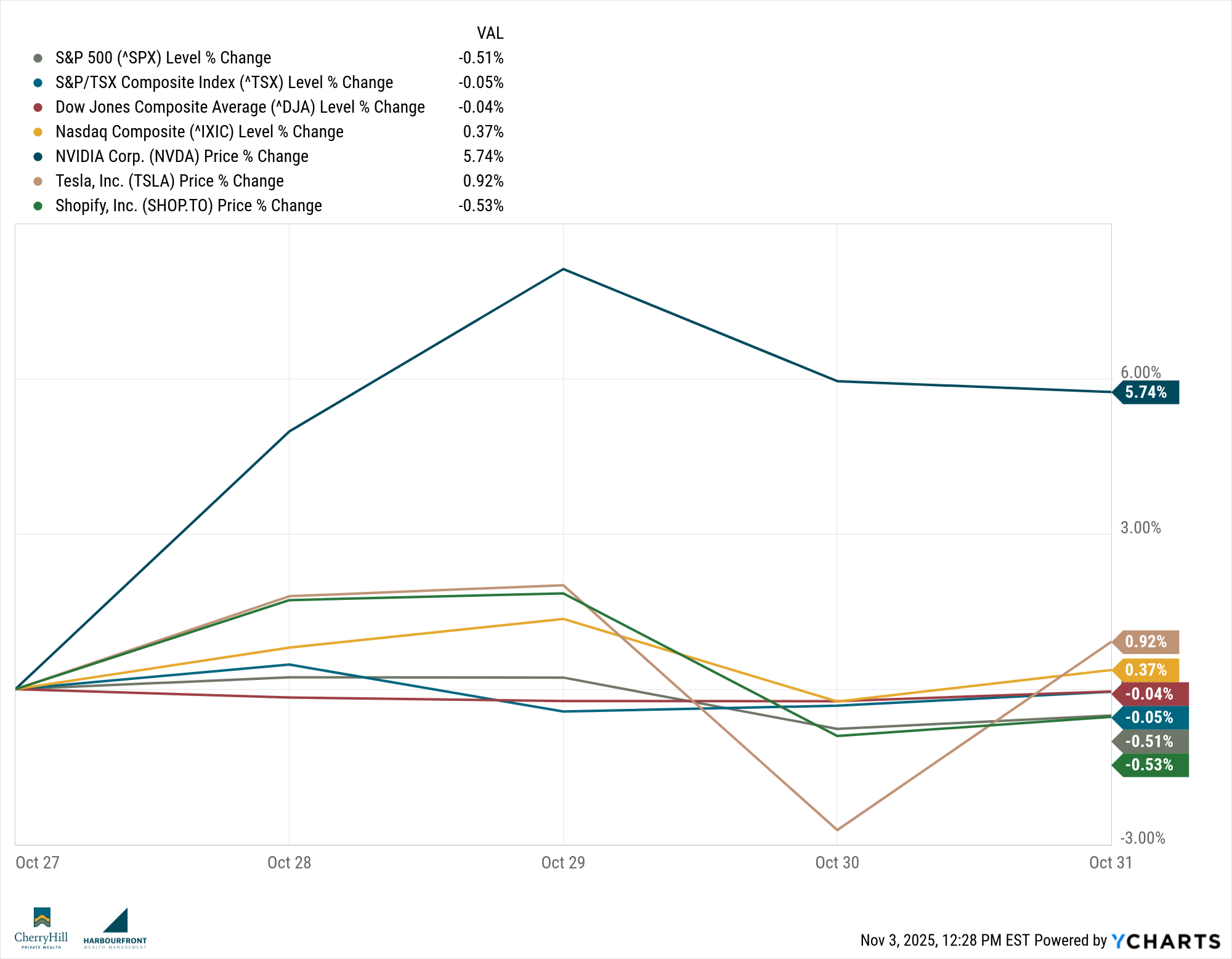
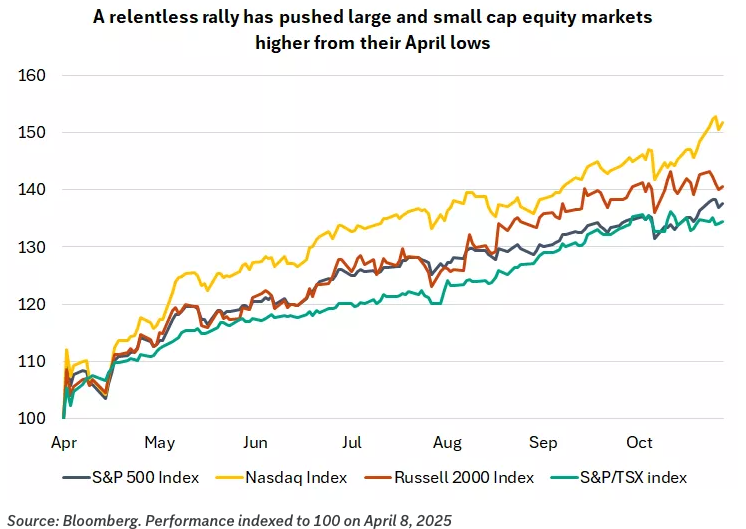
Markets showed remarkable resilience heading into Halloween, shrugging off geopolitical tensions, cautious central bank signals, and tech earnings volatility. Investors stayed focused on long-term optimism, especially around AI and improving trade dynamics.
Canadian Markets:
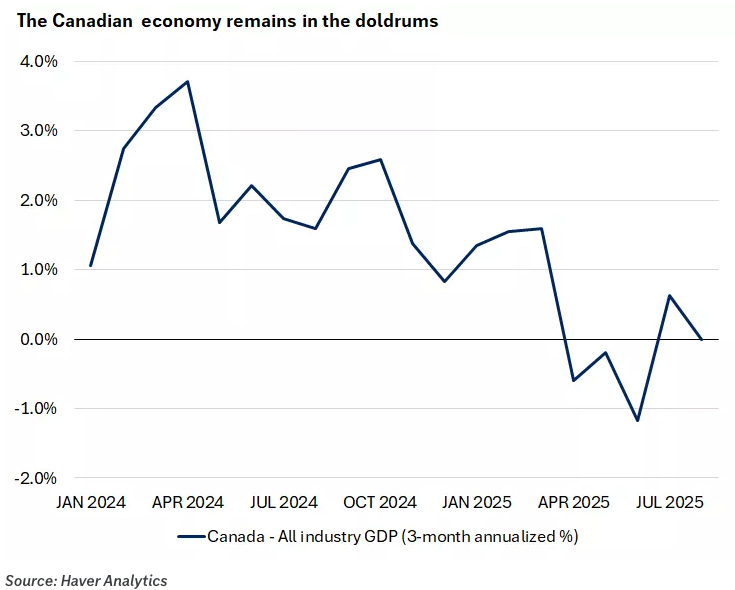
The S&P/TSX Composite Index finished the week higher (+0.9%), benefiting from strength in tech and industrials. The Bank of Canada cut rates by 25 basis points to 2.25%, but signalled a more cautious stance going forward. Governor Macklem noted that further cuts would require an “accumulation” of evidence. Expectations for additional easing were already subdued, and the reaction in bond markets was relatively muted. Investors are now turning their attention to the upcoming federal budget, expected November 4, which may include increased spending on infrastructure and housing.
U.S. Markets:
U.S. stocks ended October on a high note. The S&P 500 rose +1.1%, the Nasdaq gained +2.2%, while the Dow Jones added a modest +0.4%. A mixed batch of tech earnings didn’t derail enthusiasm, with Amazon’s 10% surge on Friday helping lift indices. The Federal Reserve cut rates by 25 basis points, moving the fed funds range to 3.75%–4.00%, but Chair Powell made it clear that a December cut is far from guaranteed. Bond yields rose slightly, with the 10-year Treasury yield ending the week at 4.08%, as investors recalibrated expectations.
Global Markets:
Global equities also gained ground. European markets advanced, bolstered by easing inflation and stronger earnings. In Asia, markets welcomed a temporary thaw in U.S.–China trade tensions. A high-stakes meeting between Presidents Trump and Xi resulted in tariff pauses and renewed agricultural purchases, calming earlier fears of an escalation. However, trade talks between the U.S. and Canada remain stalled. Meanwhile, Japan’s Nikkei ticked higher, supported by stimulus optimism.
Sector Spotlight:
Technology remained the market’s engine despite volatility in earnings reports. While Microsoft and Meta disappointed, Apple and Amazon delivered strong results, fueling optimism around the AI trade. The AI-driven rally pushed the Nasdaq and S&P 500 to new all-time highs, with year-to-date gains nearing 40%. Questions about a potential bubble persist, but Fed Chair Powell pushed back, citing solid earnings and fundamentals across major players.
Quote of the Week:
“Markets can remain irrational longer than you can remain solvent.”
— John Maynard Keynes
Trends to Watch This Week:
Here’s what were watching this week:
- Canadian Federal Budget (Nov. 4): Markets will analyze infrastructure and housing investments for potential economic tailwinds — or deficit concerns.
- U.S. Government Shutdown: Now approaching record length, the economic impact is estimated at a $40B drag if unresolved into November.
- Inflation Watch: Both Canadian and U.S. policymakers remain data-dependent. Upcoming inflation readings could sway future rate-cut expectations.
- Earnings Season Wrap-Up: Markets will watch the tail end of reporting season to see if broader profitability remains resilient outside tech.
Summary
Despite a wall of worry — from rate-policy uncertainty to political gridlock and tech sector scrutiny — markets continue to grind higher. While short-term volatility may increase, especially with key data delays and policy ambiguity, investor sentiment remains broadly optimistic heading into the final stretch of 2025. With strong earnings and easing trade tensions, the foundation for continued growth looks intact.
Final Thought
After the emotional rollercoaster many of us experienced this weekend, we’re officially back to “normal” — or at least trying to be.
Before moving on from the improbable run the Blue Jays were on, I wanted to take a moment to reflect on what was truly an incredible season. Heading into the weekend, the Jays looked like a lock to win the World Series, but a few costly mistakes arguably changed the outcome.
That’s not to take away from what they accomplished — as fans, we should be proud. But it’s also a reminder that in championship-level moments, it’s often the mistakes that matter more than the highlights.
We think about this the same way when it comes to the advice we provide our clients. Our mission is to minimize errors and protect the lead. We’re not always swinging for the fences — instead, we aim to deliver consistent, quality at-bats that keep us moving forward.
That said, our defense is elite. Whatever the market throws your way, we’ve got a Gold Glove strategy to keep you covered.
Until next time, stay informed and strategically invested!
Trevor