


What CPP’s New Report Tells Us About Investing Smarter
In today’s email:
- How does a 10-year 9.2% annualized return sound?
- What can we learn from a “conservative” portfolio that has amazing, consistent returns?
- Trade policies continue to be front of mind, but tech companies don’t seem to care.
- Markets are doing well, but what areas are in line for the best results?
The Scoop
Canada Pension Plan Investments (CPP Investments) recently released its annual report, and the results were eye-opening—not just because the fund hit an all-time high of $714.4 billion in assets, but because of how it got there. It’s a useful reminder of the approach we mirror here in the Watermark Private Portfolio: long-term thinking, global diversification, and alternative investments.
Let’s break it down.

What Is the CPP Doing Right Now?
CPP Investments returned 8.0% this past fiscal year, pushing its 10-year annualized return to 9.2%. That’s impressive—especially for a fund mandated to be prudent and risk-aware. So, how are they doing it?
Here’s a snapshot of their portfolio:
- 29% Private Equity
- 11% Credit
- 16% in Real Assets (7% Real Estate, 9% Infrastructure)
- 29% Public Equities
- 15% Government Bonds
Even more interesting is their global approach:
- Only 12% of the fund is invested in Canada
- Nearly 50% is in the U.S., with the rest spread across Europe, Asia-Pacific, and Latin America
This is a sophisticated, institutional strategy that most individual investors haven’t traditionally had access to. Until recently.
How We Mirror This at Watermark
When we created the Watermark Private Portfolio, we were inspired by funds like CPP, the Yale Endowment, and other major pension and institutional investors. Their secret? A shift away from the traditional 60/40 public stock/bond split.
In our portfolios, you’ll find:
- Private Credit and Private Real Estate, which can offer stable income and lower volatility
- Infrastructure and Private Equity exposure, providing long-term growth potential
- Hedged Strategies, which help reduce drawdowns when markets become unpredictable
We also believe in global diversification, not just for growth, but for resilience. CPP’s global footprint reinforces our view that you can’t build a modern portfolio with a “Canada-only” mindset.
Why It Matters Now
Markets have been hitting new highs—but so have risks. The global economy is dealing with shifting interest rates, political uncertainty, and slower growth in key regions like China. CPP’s recent allocations suggest they’re preparing for a more complex investment world, not a simple return to the way things were.
That’s exactly why we’ve built portfolios designed to be more adaptive and more resilient. Whether it’s navigating inflation, protecting against downside risk, or capitalizing on long-term opportunities, the Watermark Private Portfolio is built with the same thinking that guides one of the world’s largest and most successful pension plans.
Final Thoughts
If you’re wondering what the “smart money” is doing right now—this is it. And the good news? You don’t need $700 billion to invest this way.
We’d love to walk you through how this applies to your specific situation.
Market Minute
This past week, global markets exhibited mixed performance, influenced by robust corporate earnings, particularly in the tech sector, and ongoing geopolitical tensions. Investors navigated a landscape marked by strong economic indicators and policy uncertainties.
Canadian Markets:
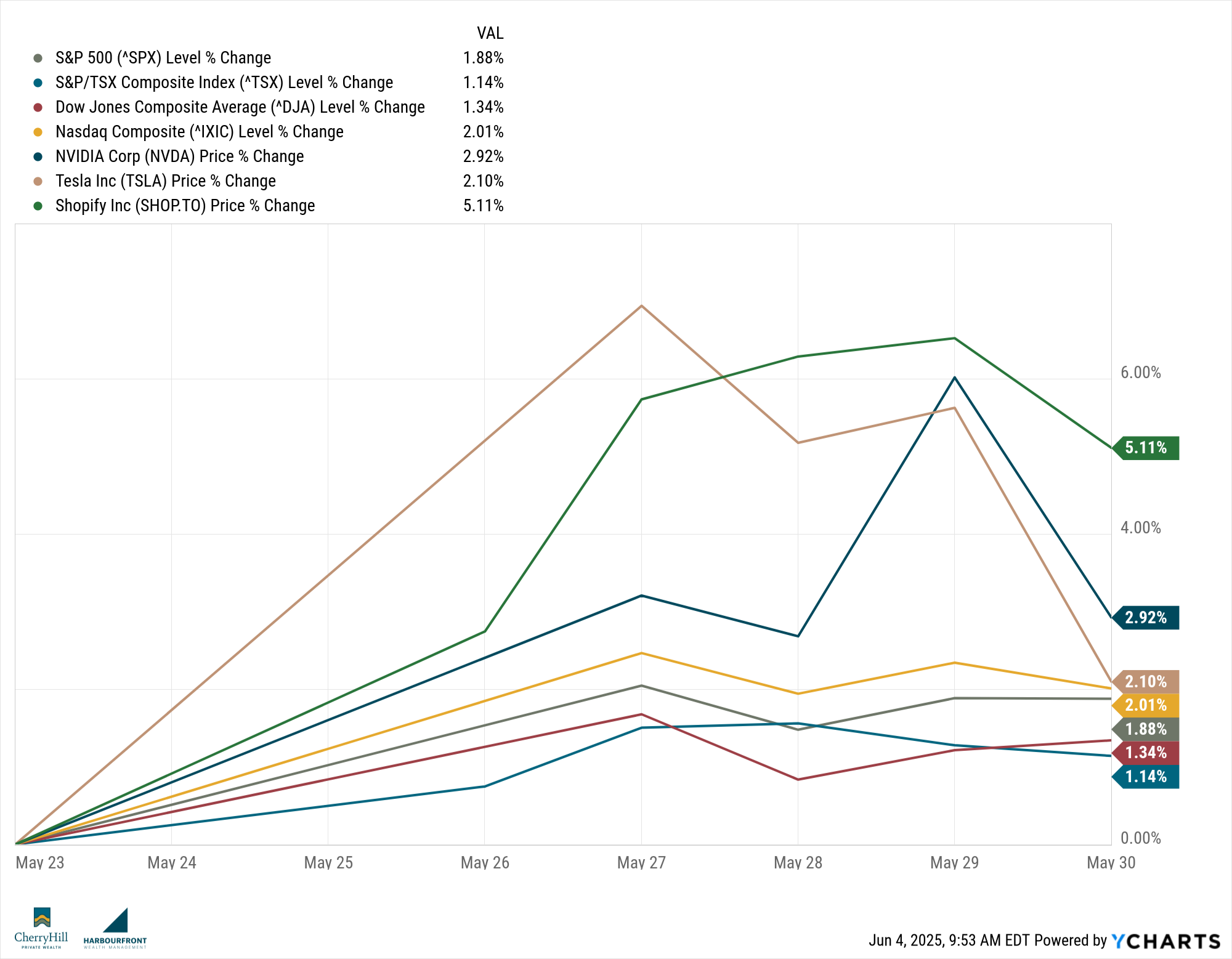
The TSX Composite Index experienced modest gains, buoyed by strength in the energy and financial sectors. Energy stocks benefited from rising oil prices, while financials were supported by stable interest rate expectations. However, concerns over global trade tensions and their potential impact on Canada’s export-driven economy tempered overall market enthusiasm.
U.S. Markets:
U.S. equities advanced, driven by impressive earnings reports from mega-cap technology companies. The S&P 500 Index rose approximately 1.9%, while the Nasdaq Composite gained around 2.0%, reflecting investor optimism in the tech sector. Notably, NVIDIA’s strong quarterly results, highlighting a 73% year-over-year increase in its data-center business, underscored the sustained demand for AI-related technologies. However, trade policy remained a focal point, with the U.S. administration delaying the implementation of proposed tariffs on European imports until July 9, providing temporary relief to markets.
Global Markets:
European markets posted gains, supported by improved consumer confidence in Germany and the postponement of U.S. tariffs on EU goods. The FTSE 100 and DAX indices both closed higher, reflecting positive sentiment. In Asia, markets were mixed; Japanese equities advanced on expectations of continued monetary stimulus, while Chinese markets faced headwinds due to ongoing trade uncertainties and domestic economic concerns.
Trends to Watch This Week:
- U.S. Employment Data: The upcoming nonfarm payrolls report will provide insights into the labor market’s health and its implications for monetary policy.
- SM Services PMI: Investors will monitor the Institute for Supply Management’s services index for indications of economic expansion or contraction in the services sector.
- Trade Negotiations: Developments in U.S.-China and U.S.-EU trade talks will continue to influence market dynamics, especially as tariff deadlines approach.
Summary:
Markets demonstrated resilience amid a complex backdrop of strong corporate earnings and geopolitical challenges. While the technology sector’s robust performance provided a boost, trade policy uncertainties and economic data releases will be critical in shaping investor sentiment in the coming weeks.
Final Thought
It used to be that peace of mind came at a massive cost to your return potential. We used to only be able to move to cash or something like gold in times of turmoil. Today, with our team, you can reduce your risk in much the same way, but without giving up all or most of your returns.
As the U.S. continues to try and change the geopolitical landscape, we continue to see swings in the market both for the positive and negative. Ensuring that we have the proper allocations to equities (if that’s what your risk tolerance calls for), as well as exposure to alternatives, will help to maximize our returns and protect us from the slides.
Until next time, stay informed and strategically invested!
Trevor