


Noise vs. Reality: What the Market Is Really Saying
In today’s email:
- TSX has hit new highs, but how?
- Volatility is still here (and likely for a while), what tools should you use?
- Markets were (mostly) up last week, but economic indicators were mixed.
- How do you “stay the course” so you don’t miss opportunities, but also soften the downside blows?
The Scoop
With all the negative headlines lately, it’s easy to feel like the financial world is on shaky ground. Every day brings a new headline designed to rattle investors—rising recession risks, weak GDP numbers, fresh tariff threats, and even discussions around Canadian sovereignty. But in spite of all that noise, the TSX has quietly reached all-time highs. Meanwhile, the S&P 500 has regained the ground it lost earlier in the year.
So, what gives?
At first glance, this kind of resilience seems counterintuitive. Canada’s economic growth has been sluggish, and geopolitical tensions remain unresolved. But markets are forward-looking. While economic data reflects what’s already happened, markets are constantly assessing what’s likely to happen next. And in that light, the rally makes more sense.
In Canada, rising commodity prices—particularly in energy and mining—have helped buoy the TSX, which is heavily weighted toward those sectors. Investors are also betting that interest rates have peaked, which could provide some relief to rate-sensitive parts of the market, especially financials. Even in a challenging macro environment, strong balance sheets and disciplined corporate performance can keep pushing equity markets higher.

That said, volatility is still very much a factor. One strong week doesn’t mean uncertainty has vanished. It’s during times like these—when there’s a disconnect between what we hear and what the market is doing—that investors can feel especially unsure. That’s why diversification continues to be crucial.
This is where alternative investments like private credit and private equity have a role. They’re not about chasing returns—they’re about adding stability when public markets are swinging between fear and optimism. These assets aren’t marked to market daily, and they tend to be less sensitive to the headlines that drive short-term public market moves.
Most importantly, having a thoughtful investment process and a team that doesn’t get caught up in the emotion of every headline is what helps keep portfolios on track. The noise will always be there—but the discipline to filter it out is what really makes a difference.
Market Minute
Markets exhibited mixed performance last week as investors navigated a landscape of softening economic data and anticipation of potential interest rate adjustments. Despite ongoing concerns about global growth and political uncertainties, certain sectors and regions demonstrated notable resilience.
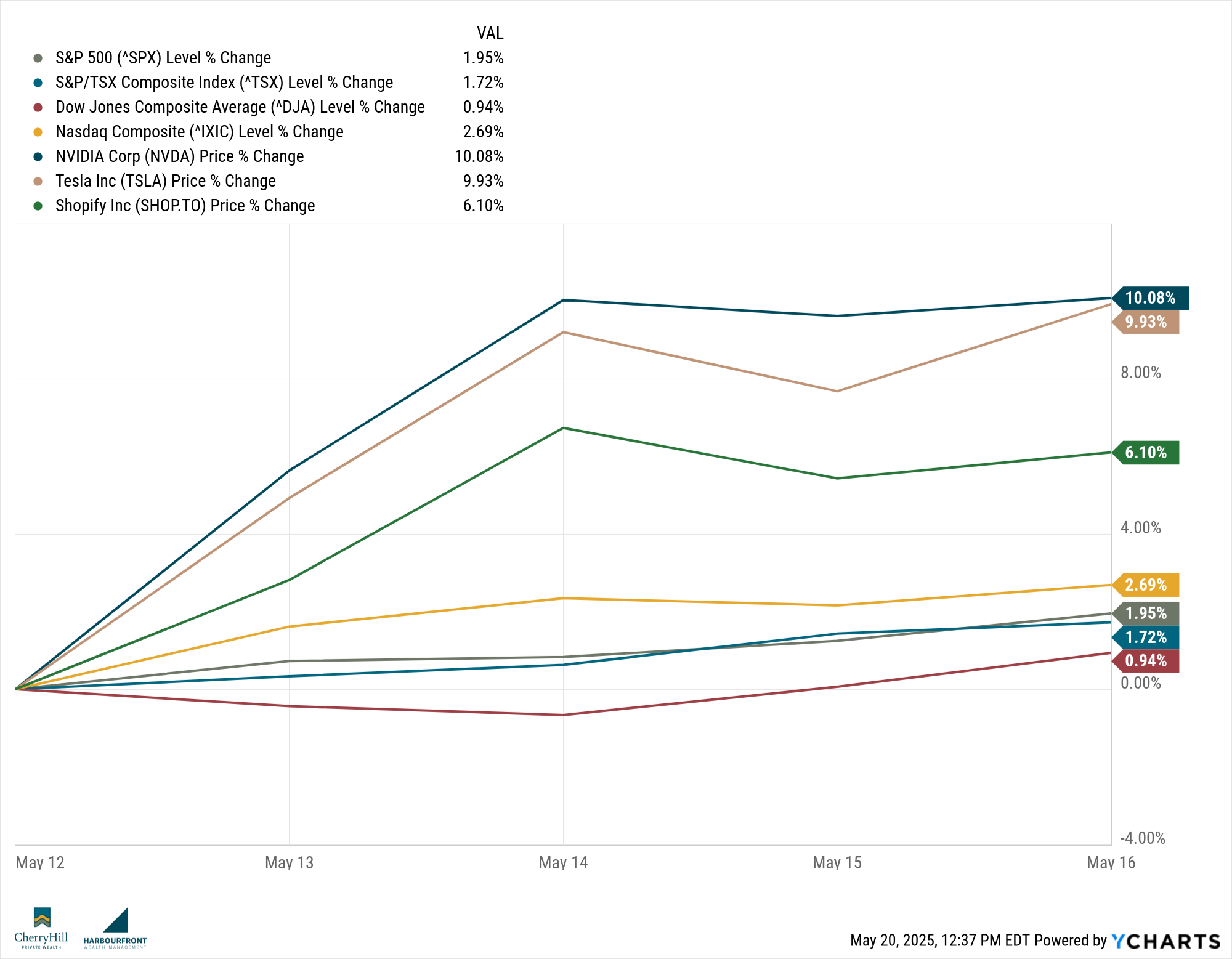
Canadian Markets:
The TSX Composite continued its upward trend, closing the week up +1.72%, setting another record high. Resource-heavy sectors like energy and materials led the gains, bolstered by firmer commodity prices and investor confidence in Canadian dividend-paying stocks. Even with weak GDP growth and rising talk of tariffs, the TSX’s performance suggests that global demand for Canadian exports and expectations for future rate relief are still driving investor interest.
U.S. Markets:
In the United States, the S&P 500 remained relatively flat for the week (+0.1%), recovering from midweek declines. The Nasdaq Composite experienced a slight pullback (-0.4%), influenced by a retreat in technology stocks following recent rallies, while the Dow Jones Industrial Average posted a modest gain (+0.3%). Economic indicators were mixed; notably, job growth figures came in softer than anticipated, reinforcing the possibility of Federal Reserve rate cuts later this year, which helped stabilize markets.
Global Markets:
European markets held steady, with the FTSE 100 flat and Germany’s DAX up +0.4%, reflecting cautious optimism amid improving inflation trends. In Asia, Chinese markets continued to face challenges due to ongoing concerns over real estate sector weaknesses and manufacturing slowdowns. Conversely, Japan’s Nikkei index gained +0.6%, supported by a weaker yen and continued central bank stimulus measures.
Trends to Watch This Week:
- Canadian Employment Data: Upcoming employment figures will be closely monitored to assess potential impacts on Bank of Canada rate decisions in the coming quarters.
- U.S. Inflation Readings: The release of June Consumer Price Index (CPI) data will be pivotal in shaping expectations for Federal Reserve monetary policy adjustments.
- Q2 Earnings Season Kickoff: Major U.S. banks are set to report earnings later this week, providing insights into the financial sector’s health and setting the tone for the broader earnings season.
Summary:
Despite persistent macroeconomic concerns and headline-driven volatility, markets continue to exhibit cautious optimism. The TSX reaching new highs and U.S. markets maintaining stability suggest that investors are positioning for a slower yet steady second half of the year, particularly if central banks begin to ease monetary policies.
Final Thought
Predictability in the markets continues to elude even the best economists. In a conversation a couple of months ago with our Portfolio Manager, Ian Goodman, he shared the disciplined approach that the Watermark team uses and it stuck with me. We’re now seeing exactly why that process matters as markets continue to ebb and flow.
Ian said something simple but important: “We can’t sell all our equity because if markets turn, we could miss a significant rebound. And those turns happen fast and without warning.”
Now, I’ve been critical of firms that throw around the phrase “stay invested” as a one-size-fits-all solution—and that’s not what I’m advocating for either. What Ian emphasized was the importance of making strategic adjustments to protect on the downside, while still being in a position to benefit from unexpected upside.
In short: Yes, stay invested—but do it with intention and discipline.
Until next time, stay informed and strategically invested!
Trevor