


Is the Private Equity Secondary Market the Smartest Corner of the Market Right Now?
In today’s email:
- Earnings reports and a contracting US economy, how did the markets handle it?
- What the heck is a private equity secondary market, and is this the place to be?
- Less volatility and potentially better returns? Tell me more!
The Scoop
Over the last few years, interest in private equity has grown steadily as investors look for returns beyond traditional public markets. But there’s one segment that even many seasoned investors haven’t fully explored: the private equity secondary market.
And in today’s environment — where many private equity funds raised record capital during the low-rate years but are now facing longer holding periods and liquidity constraints — the secondary market may be the most attractive place to gain PE exposure.
Let’s break it down.
Unicorn companies are private companies whose value is over $1B. There are 1,461 of these as of May 5, 2025.
What is the Secondary Market in Private Equity?
The “primary” private equity market involves committing capital to a new fund that will gradually deploy money over several years. But secondary markets are where investors buy and sell existing positions in those funds — often mid-life — either from other institutions or individuals looking to reduce exposure, rebalance, or raise cash.
It’s essentially a resale market for private equity. But unlike public markets, these deals happen behind the scenes through negotiated transactions, sometimes involving complex fund interests or entire portfolios.
Why the Discount?
Secondary buyers often purchase fund interests at a discount to their net asset value (NAV). These discounts exist for a few reasons:
- Illiquidity: Private equity funds have long lock-up periods, so sellers are often willing to take a haircut to exit early.
- Market timing: Some sellers want to de-risk or rebalance amid economic uncertainty.
- Perceived valuation lags: PE valuations are updated quarterly, so buyers may be cautious about potential markdowns not yet reflected in NAV.
But here’s the opportunity: many of the underlying companies in these funds are high quality — think mature, cash-flowing businesses — and buyers who are patient can pick them up at a significant discount simply because someone else needs liquidity.
What Kind of Returns Are We Talking About?
Historically, private equity secondaries have delivered strong risk-adjusted returns, often with less volatility than primary private equity. According to Preqin and other industry trackers, returns from secondaries typically fall in the mid-to-high teens range, with some vintages performing even better.
There’s a couple of reasons for this:
- You’re investing in funds that are already partially deployed, so there’s shorter duration and often more visibility into underlying companies.
- Discounts provide downside cushion and upside leverage when the underlying assets perform well.
In other words: You’re buying dollar bills for 70 or 80 cents — and getting paid to wait.
How Can This Fit in a Portfolio Today?
With public markets hovering near all-time highs and bond yields drifting lower, many investors are asking: “Where do I find value?”
Private equity secondaries can be:
- A lower-risk entry point into private equity, thanks to the built-in discount.
- A diversifier from public markets, offering exposure to companies that aren’t correlated to daily headlines.
- A liquidity solution in portfolios where cash isn’t needed immediately, and long-term compounding matters.
In the current environment — where many funds are sitting on assets longer than expected and some institutional players need to sell — this market is offering up some rare, high-quality deals.
Final Thoughts
Private equity secondaries aren’t flashy, but that’s kind of the point. They allow you to quietly acquire high-quality companies at below-market prices, often with shorter hold periods and attractive return profiles.
We believe this area will play a bigger role in diversified, modern portfolios going forward. If you’re curious how this could work for your situation — or want to better understand the trade-offs — let’s talk.
Market Minute
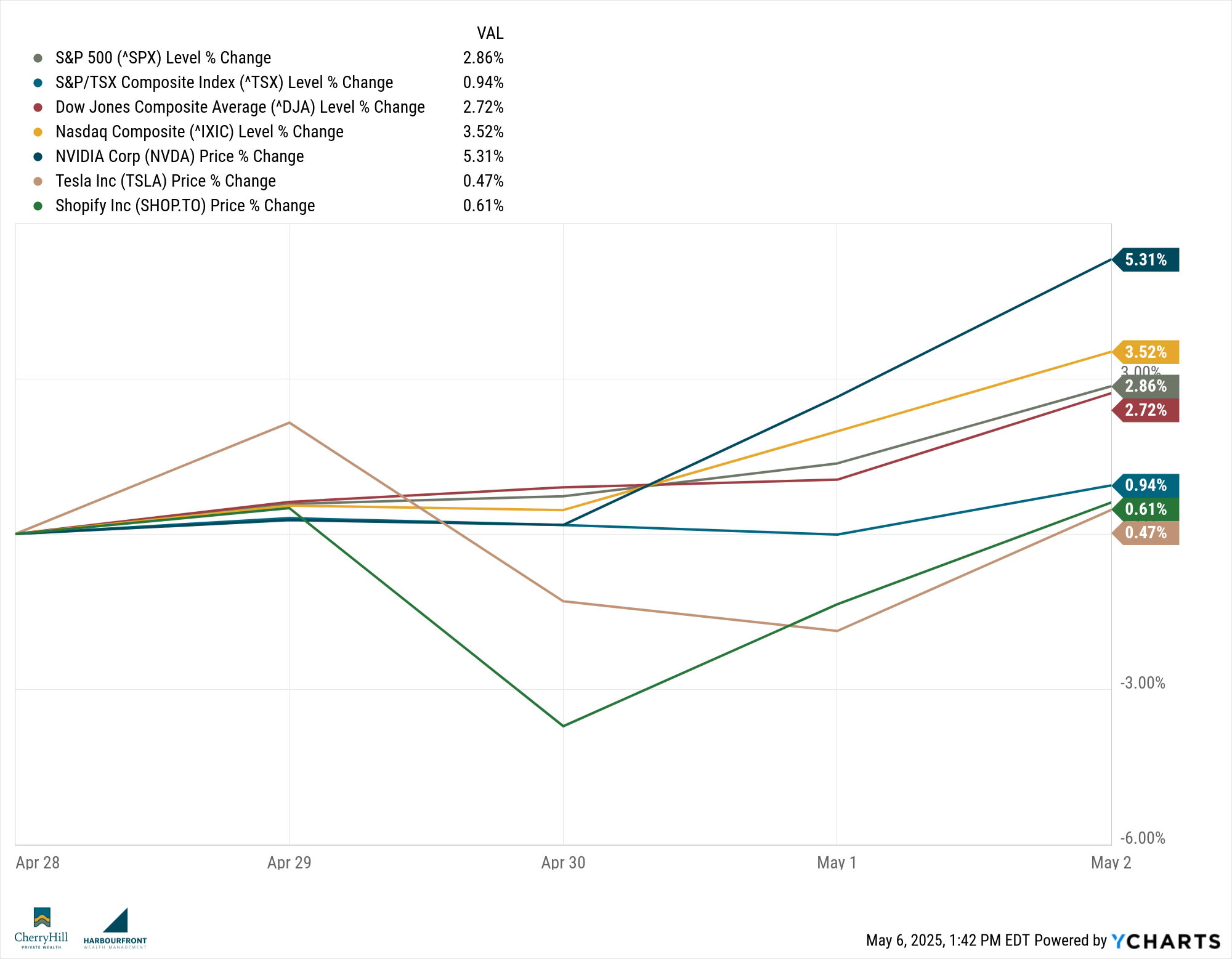
This past week, markets digested a slew of earnings, economic, and labor market data. Overall, the data, which largely looks back at the first quarter, continues to point to a U.S. economy that came into the year with solid momentum: earnings growth has surprised to the upside, GDP growth was negative (although consumption remains relatively healthy), and the labor market has been resilient with the unemployment rate remaining low.
Canadian Markets:
The TSX ended the week slightly down (-0.6%) as energy and financial sectors softened. Banks continued to navigate the shifting landscape of lower interest rates, which have pressured margins. Notably, Shopify (+4.5%) bucked the trend, reflecting optimism around tech and growth-oriented stocks.
U.S. Markets:
U.S. markets were mixed, with the S&P 500 up slightly (+0.4%) and the Nasdaq posting stronger gains (+1.2%) driven by tech and AI optimism. Apple (+3%) and NVIDIA (+5%) led the charge after upbeat analyst expectations on earnings and AI demand. Meanwhile, the Dow Jones was relatively flat, impacted by subdued performance in traditional sectors like industrials and consumer staples.
Global Markets:
European markets showed resilience despite ongoing geopolitical tensions, with the FTSE 100 (+0.7%) and DAX (+1.1%) rising on stronger-than-expected economic data from Germany. Asian markets faced headwinds as China’s slowdown continues to weigh on sentiment. Japan’s Nikkei, however, gained modestly (+0.9%) as investors anticipated further stimulus from the Bank of Japan.
Trends to Watch This Week:
- U.S. Inflation Data: Markets will closely watch the upcoming inflation figures to gauge the Federal Reserve’s next move, potentially impacting rate-sensitive sectors.
- Canadian Housing Market: Continued softening in real estate prices could influence broader economic sentiment and consumer spending.
- Tech Earnings: Major tech companies report earnings this week, with significant implications for the broader market direction.
Summary:
Markets globally remain cautious yet optimistic, buoyed by tech sector enthusiasm but tempered by uncertainty around economic data and geopolitical developments. Key data points this week will further clarify market direction.
Final Thought
Being able to look at all the available options, instead of just what has historically been sold to us can make a huge difference in the type of returns we receive as well as the volatility we have to deal with to get there. We are only 100 days into an American regime that is causing much uncertainty and volatility in the markets as they attempt to implement their mandate. I, for one, don’t want my investments to be on a rollercoaster ride for the next 4 years. Adding alternatives like secondaries and other proven options into your portfolio can drastically reduce the turmoil and even give you better returns. It’s something the ultra wealthy have done for years and pension plans have secured many retirements with this strategy. We are fortunate at Cherry Hill that we have a partner in Harbourfrount that has provided us access to many of these opportunities. If you want to know more, or you have someone you care about that is unhappy with the volatility of their investments, reach out to your advisor and they will shed some more light on this.
Until next time, stay informed and strategically invested!
Trevor