


Post-Election Playbook:
Positioning your portfolio wisely
In today’s email:
- We have a newly elected Prime Minister!
- What does this new Liberal government mean for your investments and financial future?
- Markets had a good week!
The Scoop
The results are now (pretty much) official: Mark Carney and the Liberal Party have secured a minority government. While the path ahead will require negotiation and collaboration, we already have a good sense of the direction the new government will take — and it has important implications for investors, retirees, and financial planning overall.
Here’s a quick breakdown of the key financial areas to watch:
Capital Gains Taxation: Stability for Now
One of the biggest questions heading into the election was whether capital gains taxes would rise. For now, the Liberals have confirmed they will not proceed with the previously proposed increase to the capital gains inclusion rate.
What this means: Investors can continue planning with the current capital gains structure in mind. For retirees drawing on non-registered investments, this provides welcomed stability — but future budgets will still be worth watching carefully.
Housing Markets: A Big Focus
Housing affordability remains front and centre. The Liberals plan to:
- Eliminate GST for first-time homebuyers on homes valued up to $1 million.
- Create a new Crown corporation focused on affordable housing development, including projects on federal lands.
- Cut development charges for multi-unit residential buildings by 50% over the next five years.
What this means: We could see new opportunities in residential construction and infrastructure sectors, but it will take time for affordability pressures to ease meaningfully. Real estate investments and REITs could experience a shift depending on how aggressively supply increases.
Trade and Tariffs: A Strategic Pivot
With heightened trade tensions, particularly with the U.S., the new government plans to:
- Impose retaliatory tariffs on over $60 billion of U.S. goods until their tariffs are lifted.
- Invest $5 billion in infrastructure to diversify Canadian trade routes.
- Remove internal trade barriers within Canada to boost domestic commerce.
What this means: Short-term market volatility is possible as tariffs create friction, but over the long term, diversified trade relationships could strengthen Canada’s economy. Export-oriented companies could face headwinds initially but benefit from broader international markets over time.
Retirement and Seniors’ Benefits: Small but Helpful Changes
For retirees, the Liberals have proposed several supportive measures:
- GIS payments for single seniors will increase, providing more support for lower-income retirees.
- RRIF minimum withdrawals will be reduced by 25% for one year, offering more flexibility during periods of market volatility.
- CPP, OAS, and GIS eligibility will remain at age 65.
What this means: Retirees will benefit from additional flexibility and targeted supports. Those drawing on RRIFs in particular should review their withdrawal strategies to take advantage of the temporary relief.
Energy, Infrastructure, and Climate: Opportunity and Caution
Major energy project approvals are expected to move faster, with timelines cut from five years to two. There will also be significant investment in clean energy (hydrogen, solar) and an ongoing commitment to industrial carbon pricing.
What this means: Traditional energy companies could see some support from faster project approvals, but clean energy and climate-transition sectors will likely capture a growing share of investment dollars (see our conversation about Responsible Investing here). Diversified exposure to infrastructure and renewables may be a smart long-term play.
Fiscal Outlook: Spending With Caution
The Liberals plan to:
- Run a deficit of about 2.5% of GDP over the next four years.
- Focus new spending on capital projects (housing, infrastructure, energy).
- Keep annual spending growth at around 2%, down sharply from the post-pandemic years.
What this means: The fiscal plan aims to balance growth stimulation with restraint. Inflation risks appear contained for now, but higher government borrowing could keep upward pressure on interest rates in the medium term.
Market Minute
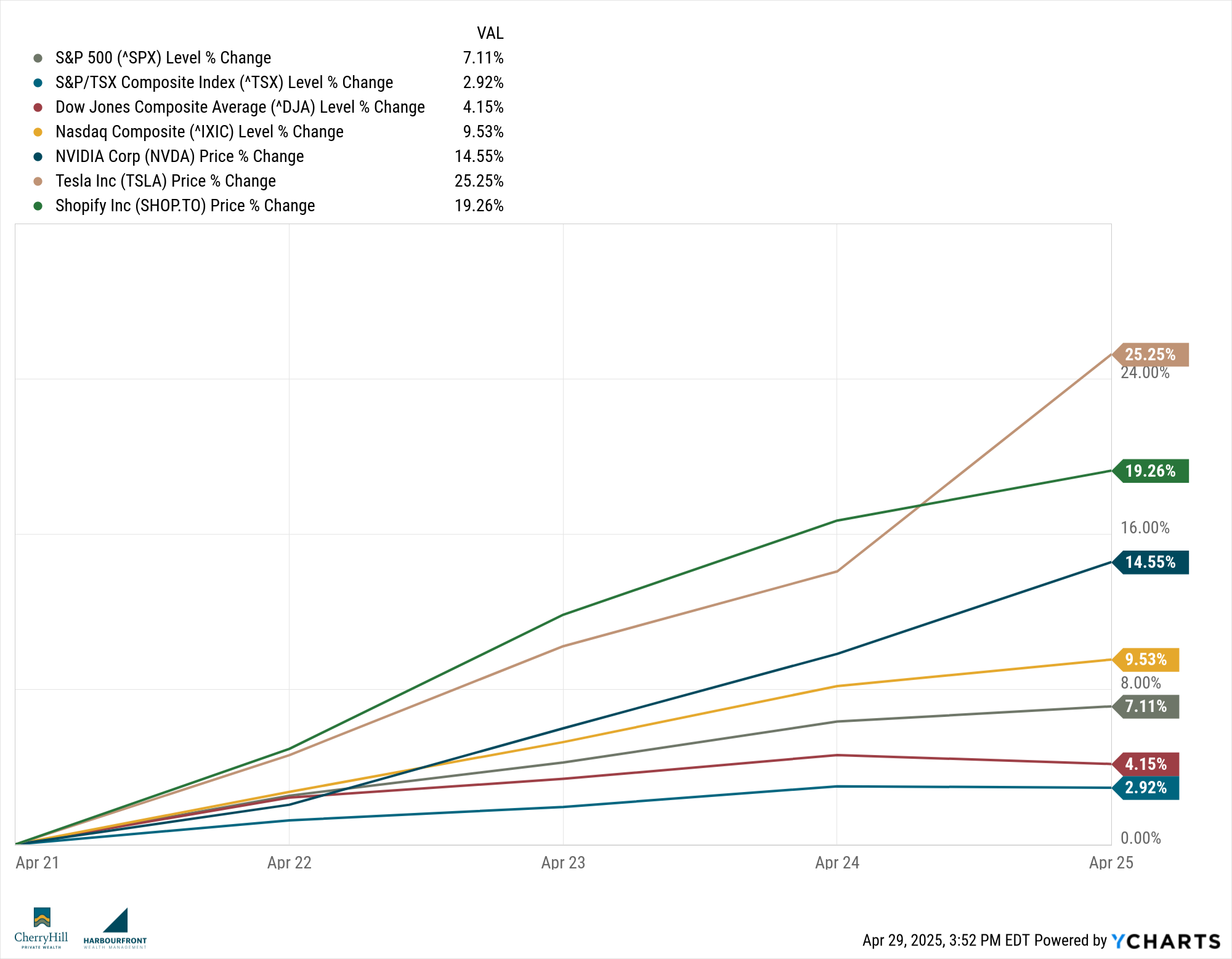
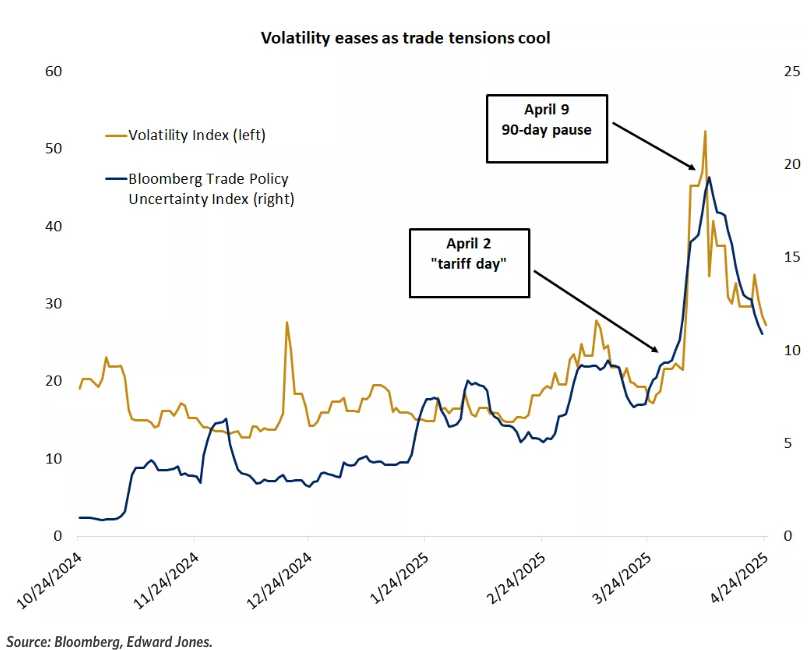
Markets rebounded last week as easing trade tensions and cooler concerns around Federal Reserve independence provided relief to investors. Signs that the U.S. is seeking to lower tariffs and ongoing progress on international trade negotiations helped lift both equity and bond markets.
Canadian Markets:
The TSX moved higher, mirroring global sentiment, supported by gains in energy and financials. A softening trade stance from the U.S. and easing volatility helped boost confidence in economically sensitive sectors.
U.S. Markets:
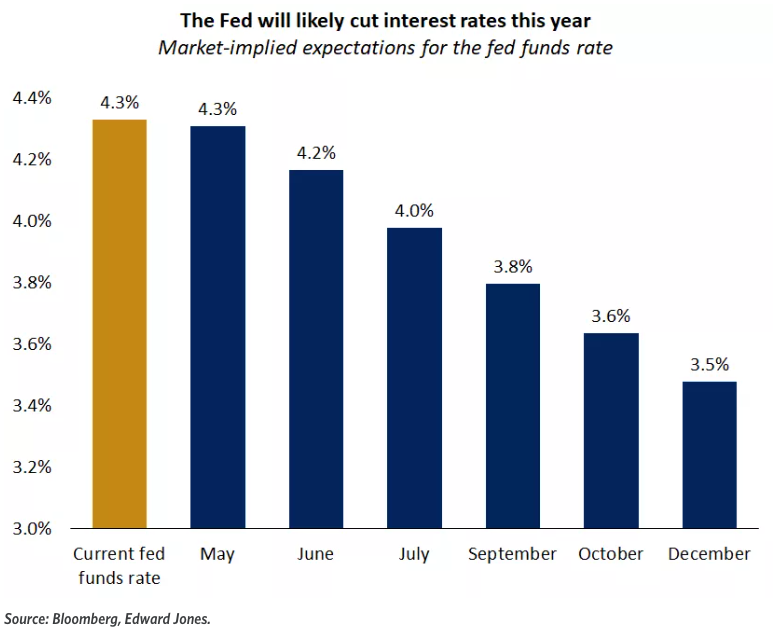
U.S. indexes staged a strong rally. The S&P 500 advanced as trade rhetoric softened and the White House hinted at possible tariff reductions with China and progress in discussions with South Korea and India. Meanwhile, the bond market priced in expectations for two to three Fed rate cuts later this year, helping broader sentiment. Corporate earnings season also started strongly, with 75% of companies exceeding profit expectations, though future earnings guidance remains cautious.
Global Markets:
International equities continued to lead gains, with European and Asian markets maintaining their edge over U.S. markets year-to-date. Reduced fears of escalating trade wars helped stabilize global outlooks, although uncertainty remains until formal trade agreements are finalized.
Trends to Watch This Week:
- U.S. Federal Reserve Meeting (May 7): Markets are focused on the Fed’s next move, with growing hopes for rate cuts starting by summer.
- Trade Developments: Watch for further announcements on U.S.-China tariffs and trade deals with other nations.
- Corporate Earnings: The heart of earnings season continues, with a focus on forward guidance given softer economic expectations.
Summary:
The past week saw markets breathe a sigh of relief as trade and Fed-related tensions eased. However, volatility could still flare up without concrete agreements. Diversification remains key, as international markets and select sectors like healthcare and financials show relative strength in a still-choppy environment.
Final Thought
We are experiencing uncertainty in world politics like never before. Many changes have been thrust on us over the past few months and there is no indication that this will lessen any time soon. As we navigate tariffs, realignments of trade partners, and many other new realities, your team at CHPW is building relationships with experts to ensure we have the right tools to navigate whatever comes next. Our team at Harbourfront continues to lead the way with innovative solutions and is able to pivot very quickly when it needs to.
As always, we are available for you, as well as, your friends and family they have any questions.
Until next time, stay informed and strategically invested!
Trevor