


What’s Your Wealth Score?
Elections, tariffs, Signal chats… let’s look at how you can be the wealthiest version of yourself!
In today’s email:
- The Five Types of Wealth — most of neglect several of these, but how do we make sure we are not just financially wealthy?
- All the tax slips have now been mailed out, but if you need them sooner, we have the answers for you.
- Our economic conversation was enlightening and we’ll have a copy for you soon!
- Markets are predictably not loving this uncertainty, but let’s see what happened last week.
CHPW Update
Tax Slips
We now have access to all the tax slips, so if you are still waiting on yours, we can send you soft copy. Please reach out to Christine (christine@chpw.ca) and she can send it over to you. Otherwise, they have been mailed out and you should receive them shortly.
Also, for those of you that missed our conversation with Ian Goodman about the state of the economy and how the WPP team protects your wealth during times of uncertainty, we will have the recording ready for you this week.
The Scoop
When most people hear the word wealth, they immediately think of money. And sure, that’s one type. But as investor and writer Sahil Bloom puts it, “If you optimize your life for only financial wealth, you’ll end up rich in dollars and poor in everything else that matters.”
I have followed Sahil for several years and have found several ideas of his that have impacted my life. When I heard he was releasing book, I immediately bought it. In the book, he outlines five types of wealth—and the reality is, most of us are neglecting a few without even realizing it. Here’s a deeper look at each, with some practical ideas from his writing that might stick with you longer than the dollar signs.

1. Financial Wealth – “I have enough money.”
The most obvious one—but maybe not the most important. Money gives you freedom, flexibility, and options. But beyond a certain point, research shows that more doesn’t necessarily mean happier. This research shows that money can buy happiness, but only to a certain point. To chase beyond that could leave you missing out on the other types of wealth. As Sahil says, “There’s always going to be a bigger boat.”
Bloom’s point: Once your basic needs and a reasonable buffer are covered, start optimizing for the other forms of wealth. Obsessing over financial growth at the cost of everything else leads to burnout and imbalance.
2. Social Wealth – “I have a strong network.”
Your relationships—family, friends, colleagues—are your true net worth. This isn’t just about “networking,” it’s about being intentional with your time and energy. I have known people who have a wide social network, but not deep. This can lead to not having that “core” relationship when you need it the most.
Key insight: Bloom references the Dunbar Number—the idea that humans can maintain about 150 meaningful relationships. But he goes deeper, suggesting you audit your social calendar with a clear lens. He encourages scheduling meaningful time with your “core relationships” the same way you’d schedule a meeting with an important client.
3. Time Wealth – “I control my schedule.”
This is the form of wealth everyone wants—especially those who’ve “made it” financially but feel trapped by their own calendars.
Bloom’s challenge: How many hours each day are truly yours? If your time is constantly owned by others, you’re not really free.
He suggests tracking your time like you’d track your money—then cutting low-value activities and saying “no” more often, especially to things that don’t align with your personal priorities.
A couple years ago I was sitting on porch with two of my best friends and one of them, who didn’t live close to his family, said “I might have 20 visits left with my parents.” Most parents realize at some point, but often too late, that that their time with with their children is limited — we get 18 summers with them (if we’re lucky) before they’re off to school or work. Knowing that there’s a finite amount of time with the people you care most about, cutting out what doesn’t feed your soul could allow you to focus on the ones that do.
4. Physical Wealth – “I am healthy and strong.”
Wealth means little if your body can’t carry you through life. Bloom talks about how this type of wealth compounds—just like investing. And just like investing, it’s easy to “start tomorrow”.
His advice: Invest 30–60 minutes a day in movement, sleep at least 7–8 hours, and protect your energy like a high-performing athlete would.
He calls this “front-loading your physical retirement” so you’re not spending your 60s and 70s paying the price for your 30s and 40s. For those of you that might not still be in your 30s or 40s, it’s still not too late. There are several things you can do on a daily basis to ensure that you don’t outlive your body.
5. Mental Wealth – “I am at peace.”
This is the quietest, but possibly most important form of wealth. Bloom describes it as a sense of calm, clarity, and control over your inner world.
Key takeaway: Mental wealth is built through boundaries, habits, and space for reflection.
He encourages readers to:
- Protect “white space” on your calendar for thinking
- Journal regularly
- And create firm boundaries around screen time and dopamine hits
He also makes a powerful distinction: Burnout doesn’t come from working hard—it comes from working on the wrong things. Mental peace comes from aligning your work and life with your values.
So… what’s your wealth score?
Take 30 seconds and rate yourself 1–10 in each of these categories or take his Wealth Score Quiz. Where are you thriving—and where do you need to invest more?
Financial planning is important—but your life portfolio is more than dollars and cents. If any of this resonates, let’s chat. We’re here to help you build real wealth—across all five areas.
Market Minute
This past week, global markets faced significant volatility, primarily driven by escalating trade tensions and renewed inflation concerns. Investors grappled with the implications of impending tariffs and economic data, leading to widespread sell-offs across major indices.
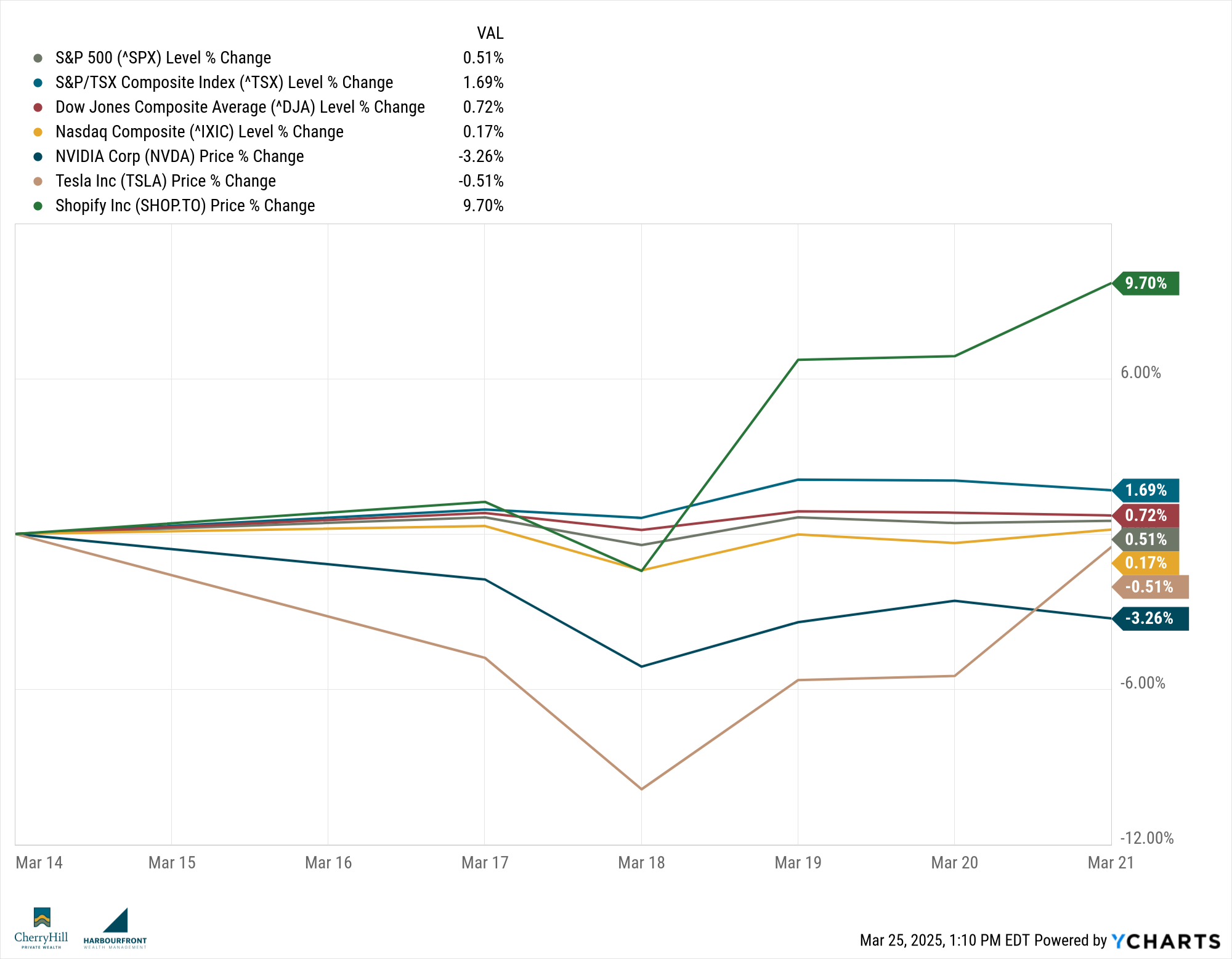
Canada:
The S&P/TSX Composite Index experienced a decline, mirroring the global downturn as trade uncertainties weighed on investor sentiment. Specific sector performances were varied, with notable movements in energy and materials sectors due to fluctuating commodity prices.
United States:
U.S. equities saw substantial losses:
- S&P 500: Dropped nearly 2% on Friday, culminating in a weekly loss of approximately 1.5%. This marks its fifth weekly decline in the past six weeks.
- Nasdaq Composite: Fell 2.7% on Friday, leading to a weekly decrease of about 2.6%. The tech-heavy index was notably impacted by significant drops in major technology stocks.
- Dow Jones Industrial Average: Declined over 700 points (1.7%) on Friday, marking its largest percentage drop since March 10. The weekly loss was approximately 1%.
Global:
International markets echoed the bearish sentiment:
- European Markets: The Stoxx Europe 600 index fell 0.8% on Friday, contributing to a weekly loss of 1.38%. The UK’s FTSE 100 declined 0.9%, while Germany’s DAX dropped 1.3%, both affected by trade concerns and sector-specific weaknesses.
- Asian Markets: Japan’s Nikkei 225 experienced a significant drop of 4% on Monday, reflecting investor apprehension over global trade developments. Similarly, South Korea’s KOSPI fell 3%, and Hong Kong’s Hang Seng declined over 1% during the week.
Trends to Watch This Week
- Tariff Announcements: Markets are bracing for President Trump’s expected announcement of new tariffs on auto imports and other goods, which could further impact global trade dynamics.
- Inflation Data: Investors will closely monitor upcoming inflation reports to assess potential impacts on monetary policy and consumer spending.
- Corporate Earnings: As the first quarter concludes, earnings reports from major corporations will provide insights into business performance amid current economic conditions.
The past week underscored the market’s sensitivity to geopolitical developments and economic indicators. As trade tensions escalate and inflation concerns persist, investors are advised to exercise caution and stay informed on policy changes and economic data releases.
Final Thought
Our team is here to help you navigate this financial landscape and help take care of the first type of wealth. Let us know what you are doing to build and maintain your other types of wealth — we’d love to hear!
Until next time, stay informed and strategically invested!
Trevor