


Money Mindset in Uncertain Times
It has actually happened this time. I wrote a two newsletters last month (here and here) when we thought tariffs were imminent, so if you haven’t checked them out yet, you might want to have a read at our take on these tariffs. Canada has also imposed counter tariffs and you can see what they encompass here. We understand that this could be a stressful and scary time for you as we try to navigate a lot of uncertainty. We are here for you if you want to discuss your portfolio, financial plan, or just try to make sense of it all. Also, remember that your friends and family are probably feeling the same, so please feel free to pass this newsletter on to them, or make an introduction and we’d be more than happy to help make sense of all of this with them.
In today’s email:
- In turbulent times, how do we focus on what matters?
- Avoid making the big mistakes.
- Canadian, U.S., and Global markets react swiftly to the U.S.-imposed trade war.
The Scoop
If there’s one thing investors can count on, it’s uncertainty. Whether it’s interest rates, inflation, geopolitical events, or market volatility, the only real constant is change. And yet, how we react to that change is what truly defines long-term financial success.
Lately, the markets have been anything but predictable. The U.S. just imposed new tariffs under Trump’s latest trade policies, escalating tensions with key economic partners, including Canada. Meanwhile, geopolitical uncertainty is at an all-time high—conflict in Gaza and Israel continues to impact energy prices, while the war in Ukraine has become even more complex. With so many factors at play, it’s no wonder emotions can get the best of us.

The Money Mindset That Works
The key to navigating this uncertainty isn’t found in timing the market or chasing the latest trend. It’s in having the right mindset. A strong money mindset means understanding the difference between short-term noise and long-term opportunity. It means recognizing our own biases and staying disciplined when the world feels chaotic.
At our firm, we take a different approach—one modeled after the strategies used by some of the world’s most sophisticated investors, including major pension funds and endowments like Yale, CPP, and OTPP. These institutions don’t just rely on stocks and bonds; they focus on risk management, downside protection, and reducing volatility through a diversified mix of assets.
Here are a few key mindset shifts that separate successful investors from those who let emotions dictate their decisions:
- Embrace Uncertainty as the NormThe markets are unpredictable, and that’s okay. Rather than fearing uncertainty, the best investors accept it as part of the journey. Volatility isn’t the enemy—it’s the price we pay for long-term growth. But managing volatility effectively is key.
- Focus on What You Can ControlYou can’t control global conflicts, trade wars, or government policy shifts, but you can control your asset allocation, risk exposure, and savings habits. Institutional investors mitigate risk by incorporating alternative investments like private credit, private real estate, private equity, and infrastructure—assets that don’t move in lockstep with public markets. This type of diversified approach smooths the ride and helps protect against the unexpected.
- Avoid Emotional Decision-MakingWhen fear or excitement takes over, mistakes happen. Chasing performance, panic selling, or constantly tweaking a portfolio based on the latest headlines rarely leads to success. Sticking to a well-thought-out plan, even when it’s tempting to react, is a key part of a strong money mindset. Many large investors also use hedging strategies to further manage risk—another key tool for maintaining discipline in uncertain times.
- Play the Long GameInvesting isn’t about what happens this week, this month, or even this year—it’s about where you’ll be five, ten, or twenty years from now. The biggest winners in investing aren’t the ones who get every call right; they’re the ones who stay invested through both good and bad times, with a strategy designed to endure.

A Final Thought
Right now, it’s easy to feel like the world is in a constant state of uncertainty. But the truth is, there has never been a time when markets weren’t dealing with some form of unpredictability. The best investors aren’t the ones who predict every twist and turn—they’re the ones who stay grounded, trust their strategy, and recognize that discipline is more important than daily headlines.
The good news? There are ways to invest that prioritize stability and reduce volatility without sacrificing growth. If you have questions about how to navigate this environment or want to ensure your portfolio is positioned for the long term, let’s chat. The right mindset, combined with the right plan, makes all the difference.
Market Minute
Markets reacted swiftly to news yesterday of tariffs being implemented on Canada and Mexico. Both countries, along with China, will implement retaliatory tariffs on U.S. good. I have included Monday’s market analysis in today’s Market Minute.
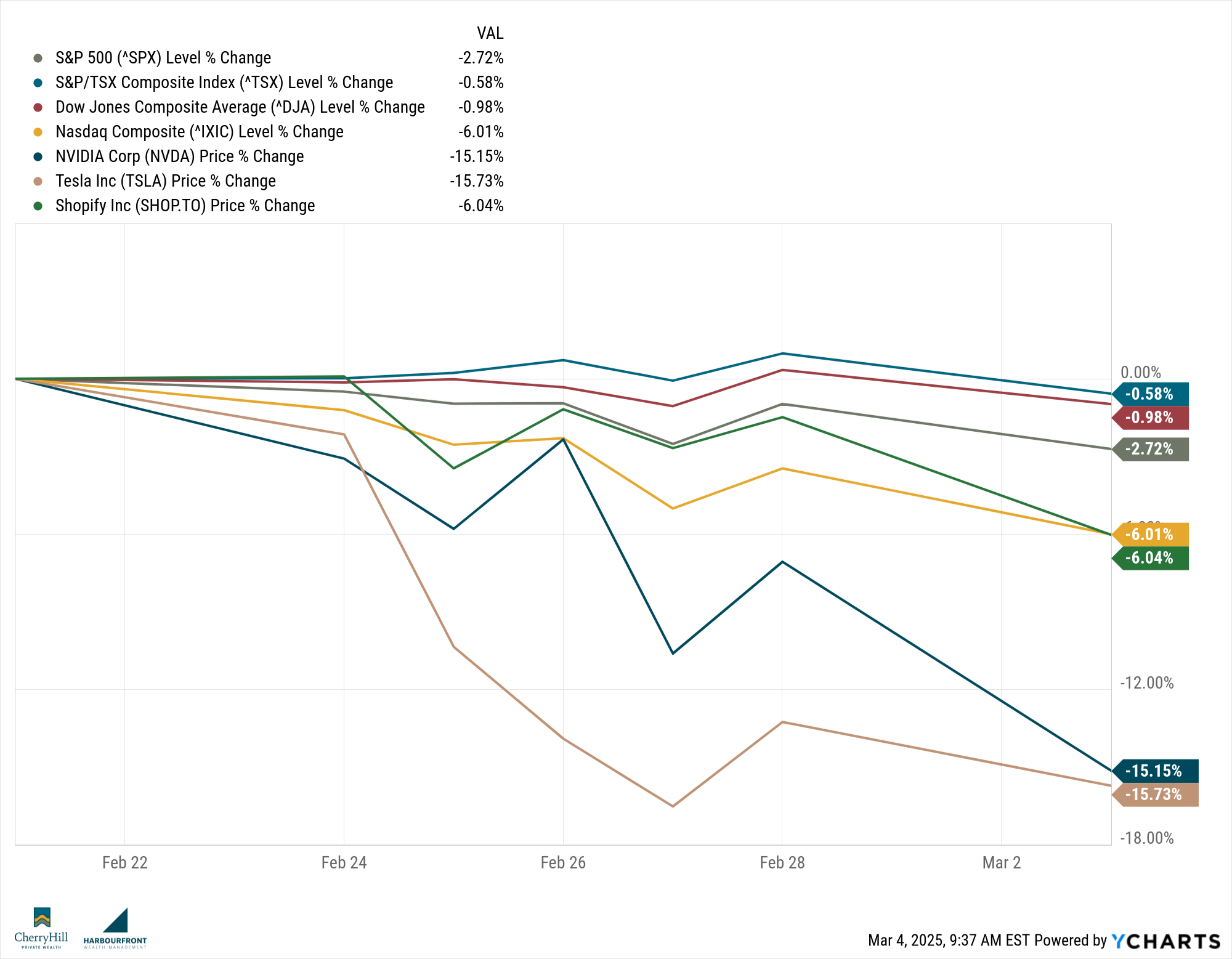
Canada:
The Canadian stock market faced challenges this past week, primarily due to escalating trade tensions with the United States. The S&P/TSX Composite Index declined by 1.2%, closing at 19,800. On Monday, March 3, the index experienced a further drop of 1.5% as investors reacted to President Trump’s confirmation of new tariffs on Canadian goods. Notably, shares of Magna International, a major Canadian auto parts manufacturer, fell by 4% in response to concerns over potential disruptions in the automotive supply chain.
United States:
U.S. markets experienced significant volatility amid renewed trade policy concerns and disappointing corporate earnings. The S&P 500 fell by 2.5% over the week, erasing its year-to-date gains, while the Nasdaq Composite dropped 3.47%. On Monday, March 3, the Dow Jones Industrial Average plummeted nearly 650 points (1.5%) after President Trump announced the implementation of tariffs on imports from Canada, Mexico, and China. This announcement heightened fears of a trade war, leading to broad market declines. Notably, Nvidia’s stock plunged 8.7% following a lackluster earnings report, exemplifying the tech sector’s struggles.
Global:
Global markets mirrored the turbulence seen in North America. European equities, as measured by the STOXX Europe 600 Index, edged up 0.6% over the week, buoyed by strong corporate earnings and gains in defence stocks, despite uncertainty over U.S. trade policy. In Asia, markets were less resilient; Japan’s Nikkei 225 tumbled 4.18%, and China’s Shanghai Composite Index decreased by 1.72%. These declines were largely attributed to concerns over escalating U.S. tariffs and their potential impact on global economic growth.
Trends to Watch This Week
- Trade Policy Developments: The implementation of new U.S. tariffs and the corresponding retaliatory measures from Canada, China, and Mexico are expected to influence global trade dynamics and market sentiment.
- Economic Indicators: Upcoming releases of consumer confidence indices and inflation data will provide insights into economic health and potential shifts in monetary policy.
As we monitor these developments, are available to discuss what this means for you and your family. Our portfolio management team is not surprised by these recent developments and has positioned the Watermark Private Portfolios for downside protection during this tumultuous time. This doesn’t mean that there won’t still be some volatility, but it will be greatly subdued.
With RRSP season behind us, we are able to take on a couple new clients this quarter. If there is someone in your life that needs some stability in their financial world, please forward them this newsletter, or make an introduction to one of our team members.
Until next time, stay informed and strategically invested!
Trevor