


From Vacations to Groceries:
How the Loonie Impacts Your Wallet
51st State? Most of us would shutter at the idea of becoming part of the US, but with the Canadian dollar more inline with the Singapore dollar, would it be so bad? My answer is still yes, but let’s have a look at what’s going on with our currency?
In today’s email:
- Inflation is finally “under control”, so what’s next? Oh, the Canadian dollar is down almost 10% year over year.
- Unemployment fell in both Canada and the US, which the stock markets did not take kindly to.
- Are there still affordable places to travel?
- The LA fire has left massive devastation, which has been compounded by insurance companies in the area removing fire coverage recently. Do you know what natural disasters your covered for?
The Scoop
Many of us are looking to head South for a quick reprieve from the Canadian winter (as I’m writing this, my hometown of Sudbury is a balmy -27). Unfortunately, our Canadian dollar is making much more difficult to put our toes in the sand right now. Let’s take a quick look at why the Loonie has struggled so much recently, what is getting more expensive, what is staying the same, and I’ll even suggest a couple places to travel where the dollar goes further in the Lighter Side.
Recent Developments
As of early January 2025, the Canadian dollar has been trading around 69 to 70 cents USD. This marks a significant decline, with the loonie losing nearly 8% against the U.S. dollar in 2024, its largest annual drop since 2015.
Several factors have contributed to this decline:
- *Political Uncertainty: *Prime Minister Justin Trudeau announced his resignation, leading to increased political uncertainty. With Parliament “on vacation” until late March, this increases the uncertainty with Canada’s future.
- *U.S. Trade Policies: *President-elect Donald Trump has threatened to impose a 25% tariff on Canadian imports, adding pressure to the Canadian economy. As politicians scramble to meet demands to secure the border and equalize a trade deficit amongst others, much of this will be costly to Canadians.
- Interest Rate Differentials: The Bank of Canada has reduced its benchmark interest rate by 1.75 percentage points since June to support the economy, widening the gap with U.S. rates.
What’s Getting Pricier?
- *Vacations Abroad: *If you’ve been dreaming of sipping margaritas on a Mexican beach or exploring Europe’s charm, brace yourself. Flights, hotels, and that fancy bottle of duty-free tequila will cost more.
- Imported Goods: Everything from electronics to out-of-season fruits (looking at you, February strawberries) will see price hikes. Those avocado toasts? They might just become a luxury item.
- *Online Shopping: *Love snagging deals from U.S. retailers? Watch out for extra currency conversion charges. That $50 sweater might look like a steal… until your credit card bill arrives.

What’s Getting Cheaper (or Staying Steady)?
- Canadian Exports: A silver lining for businesses exporting goods like lumber, oil, and, yes, maple syrup. A weaker loonie makes our products more competitive on the international stage. Hopefully that benefit isn’t eroded with increased tariffs in a couple weeks.
- *Tourism in Canada: *Thinking of exploring the Rockies or visiting Prince Edward Island? Now’s a great time. A lower dollar attracts foreign tourists and makes domestic travel more appealing.
- *Local Products: *Buying Canadian-made products or produce in season can help keep costs in check. It’s time to rediscover your love for local apples, folks! Time to embrace local produce and homegrown brands!

Historical Context and Ideal Value
Historically, the loonie has seen various levels. In the early 2000s and again in 2016, it hovered around similar values as we’re seeing today. An ideal range might be 85-90 cents USD, balancing affordable imports with competitive exports. However, currency markets are influenced by numerous factors, making such stability challenging.
Looking Ahead
The future of the Canadian dollar will depend on:
- Economic Policies: Changes in government and fiscal strategies will play a significant role. This could be a whole newsletter in itself, but in short, policies promoting fiscal discipline, trade diversification, energy efficiency, and monetary stability are key to increasing the Canadian dollar’s value. These efforts need to be balanced with maintaining a competitive edge in exports to avoid pricing Canadian goods out of the global market.
- Global Trade Dynamics: International relations and trade agreements will continue to impact the loonie’s value. Decreasing our dependency on US exports would go a long way to avoiding ridiculous conversations about becoming the 51st US State, as well as, creating a stable dollar.
- Commodity Prices: As a major exporter of natural resources, global demand and prices for commodities like oil will influence our currency.
For now, consider the Canadian dollar your unpredictable adventure buddy. Sometimes it pays for dinner; sometimes it forgets its wallet entirely. Staying informed and adaptable will help you navigate these financial twists and turns.
You can also consider investing in USD when the dollar is stronger. We offer the option to open USD accounts, which can be beneficial for managing travel expenses and other currency-based costs during times of unfavorable exchange rates.
Market Minute
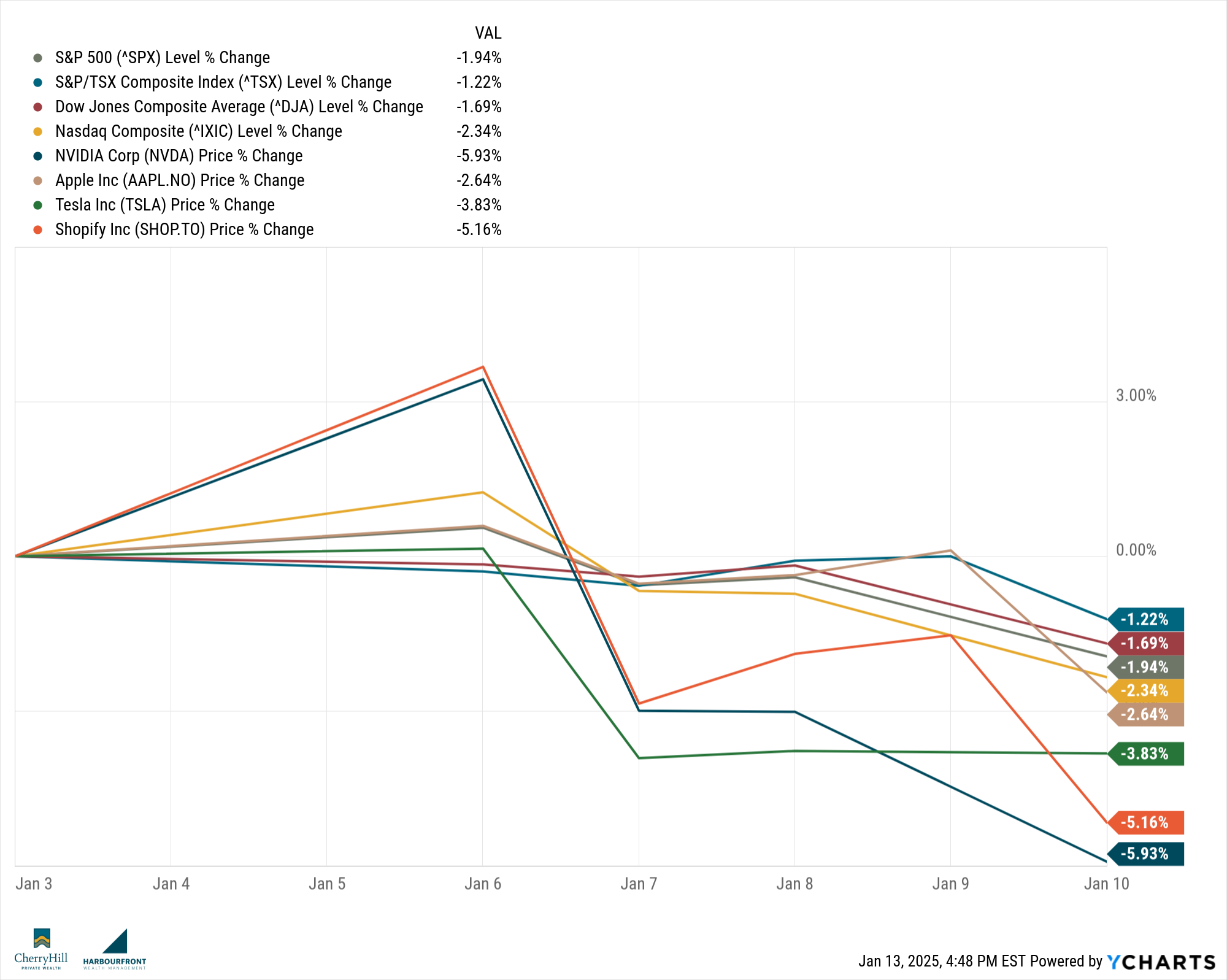
After a strong start to 2025, we saw sharp declines in both Canadian and US markets. This was primarily due to robust employment data that tempered expectations for further interest rate cuts this year.
United States:
- Market Performance: After initial upward ticks for both the Nasdaq and S&P 500, both indicies, along with the Dow, fell to finish off the week. The Nasdaq fell the most to close out the week, finishing -2.34% on the week, while the Dow fell -1.69% and the S&P 500 saw declines of 1.94%.
- *Economic Data: *U.S. employers added 256,000 jobs in December, surpassing economists’ expectations of 165,000. The unemployment rate fell to 4.1% from 4.2%. Average hourly wage growth rose 3.9% year-over-year, slightly below forecasts of 4.0%.
- Market Reaction: The strong employment figures raised concerns that the Federal Reserve might delay anticipated interest rate cuts, leading to a rise in bond yields and a subsequent decline in stock prices.
Canada:
- Market Performance: Over the past week, the Canadian market dropped 1.22%, driven by a pullback of 2.1% in the Financials sector.
- *Economic Data: *Canada’s employment rose by about 91,000 in December, significantly exceeding expectations of 25,000, driving the unemployment rate down to 6.7% from 6.8%. Wage gains in Canada also eased to 3.7% year-over-year, below estimates of 3.8%.
- Market Reaction: The unexpected acceleration in job growth ignited fears that the Bank of Canada might maintain elevated interest rates, contributing to the stock market decline.
Trends to Watch
In the US, there are several reports that are being released this week. Today, the *Producer Price Index (PPI) *will be released, which is a critical indicator of wholesale inflation. Tomorrow, the *Consumer Price Index (CPI) *data will be released, which provides insights into consumer inflation. We will also be watching the *Retail Sales Data *(released Thursday), and Housing Starts (Friday). These reports will give a good light on the health of the US economy.
In Canada, there are several reports that are set to be released as well. This week we’ll see reports on Manufacturing Shipments, Wholesale Trade, and International Securities Transactions. The Housing Starts for December will also be released this week, which indicates the number of new residential construction projects initiated.
Investors will closely analyze these economic reports and earnings releases to gauge the economy’s health and corporate profitability. Particular attention will be on inflation data (PPI and CPI) to assess potential impacts on monetary policy, especially regarding interest rate decisions by the Federal Reserve.
Overall, this week’s data and earnings reports are crucial for understanding economic trends and making informed investment decisions.
The Lighter Side
Vacations. They’re good for the soul, but with the dollar in a funk, are they good for the pocket book. Last year, when the Canadian dollar was about $0.75 USD, a $5,000 getaway would have cost about $6,667 Canadian. This year, that same trip today, costs about $7,246. Which is a $580 increase!
Where can we go to escape the snow and cold and not break the bank? Let’s take a look at a couple options.
- MexicoWhy its a good idea: While prices might still be higher, Mexico remains an affordable option for Canadians. The Mexican Peso has also faced some pressure, helping offset the loonie’s decline. Once you’re there, food, accommodations, and activities are very budget-friendly.

-
South AmericaWhy its a good idea: Destinations like Argentina and Colombia can be excellent choices, as their currencies have also seen volatility. Argentina, in particular, has become a favorite for budget travelers looking to enjoy fine wine, stunning landscapes, and rich culture at a fraction of the cost of other destinations.
-
Central America*Why its a good idea: *Countries like Costa Rica, Guatemala, or Nicaragua offer incredible value. While the loonie may not be as strong as it once was, these destinations remain relatively affordable due to lower overall costs for lodging, food, and experiences.
-
Southeast AsiaWhy its a good idea: If you’re willing to travel farther, Thailand, Vietnam, and Indonesia continue to offer excellent value. The Canadian dollar goes further here, with affordable luxury accommodations, delicious food for just a few dollars, and inexpensive transportation options.
-
Domestic Travel in CanadaWhy its a good idea: Staying within Canada is the easiest way to avoid exchange rate issues. Plus, with the lower loonie, foreign tourists are flocking here, making it a great time to explore our own backyard. Whether it’s skiing in Banff, wine tasting in the Okanagan, or hiking on Vancouver Island, there’s plenty to enjoy.Bonus: Supporting the local economy feels good, too!



Where are you looking to travel in 2025? Has the weak loonie had you thinking twice?
The CHPW Team
Many of you have likely been following the devastating fires that have engulfed LA this past week. I, personally, have several friends in the area and as I’m writing this, a few have lost homes. Hearing the heartbreaking accounts of the devastation has got me thinking about a conversation we had on the How Canada Works Podcast a couple months ago.
Canada has had it share of fires and floods the past couple years and these events don’t seem to be slowing down. In the US, and specifically California, some insurers have cancelled the fire coverage, which is leaving many affected in the area with no insurance (read the story here). We spoke to Sam Pietras about insurance and natural disasters in Canada and now seems like a great time to give it another listen. You can check out our conversation with her on Episode 4.
Until next time, stay informed and strategically invested!
Trevor