


Planning for Success: From Blue Mountain’s Peaks to Your Financial Goals
My wife has informed me that it is now officially less than one month before Christmas - I think this is a “gentle” reminder to get the lights up!
In today’s email:
- Every successful business sets aside time each year to reflect on the year that was and plan for the years to come - shouldn’t families do the same?
- The DJIA and TSX both hit new highs last week, let’s have a look at how they got there.
- Black Friday is here, so let’s take a look at some of the weirdness around the second biggest shopping day of the year.
- After 33 years as a radio morning show host, she started her own business. What does it take to start a business in retirement, we find out.
The Scoop
Greetings from Blue Mountain! This week, our team is away to finalize our 2025 business plan, taking a step back from day-to-day operations to focus on strategy, priorities, and vision. It’s been an incredible exercise to refine our goals and map out how we’ll achieve them, and it reminded me of the work we do with our clients every day—helping them build personal financial plans.
The parallels between building a business plan and building a personal financial plan are striking. Both processes require a clear understanding of where you are today, where you want to go, and the steps to get there. Both also require reflection, prioritization, and a willingness to adapt as life (or the economy) changes. So, let’s dive into how these two kinds of planning compare and contrast.

The Foundations: Setting Goals
In business planning, the first step is defining the company’s mission and vision. What do we want to achieve as an organization, and what does success look like for us? This might include revenue targets, market expansion, or expanding services.
Similarly, in personal financial planning, we start by identifying your goals. Do you want to retire early? Buy a vacation home? Send your kids to university without student loans? Success in financial planning looks different for everyone, but having a clear picture of what you’re working toward is essential.
Assessing the Current Landscape
Once a business defines its goals, it’s time to assess where it stands. This involves looking at the company’s financials, market position, and internal strengths and weaknesses. It’s not always fun to confront the numbers or admit where things aren’t working, but it’s necessary.
The same holds true for personal financial planning. Before charting a course forward, we need to understand your current situation—your income, expenses, assets, and liabilities. Do you have an emergency fund? Are your investments aligned with your risk tolerance? It’s all about taking stock before moving forward.
Creating a Strategy
With a clear understanding of goals and current circumstances, businesses develop strategies to achieve their objectives. This might involve investing in new technology, hiring talent, or expanding into new markets. Every decision is made with an eye on how it will contribute to long-term success.
In personal financial planning, the strategy involves setting a budget, creating a savings plan, and investing wisely. Just like a business invests in growth, individuals invest in their future—whether that means contributing to a retirement account, paying off debt, or building a diversified portfolio.
Managing Risk
Both business and financial plans must account for risks. Businesses consider market competition, economic downturns, and operational challenges. Mitigation strategies like diversifying revenue streams or securing insurance are part of the plan.
For individuals, managing risk means having the right insurance coverage, building an emergency fund, and ensuring your investments align with your time horizon and risk tolerance. It also means being prepared for unexpected life events, like illness or job loss.
Monitoring Progress and Adjusting
A business plan isn’t set in stone; it’s a living document that evolves as circumstances change. Companies regularly review their plans, measure progress against key performance indicators, and make adjustments as needed.
The same is true for personal financial plans. Regular check-ins allow us to evaluate your progress, celebrate milestones, and adjust for changes in your life or the market. Whether it’s a new job, a growing family, or a shift in economic conditions, your financial plan should evolve with you.
Why Both Are Worth the Effort
Planning—whether for a business or personal finances—takes time and effort. It’s not always easy, and it requires discipline to stick to the plan once it’s in place. But the rewards are undeniable. A well thought out plan provides clarity, reduces stress, and sets you up for long-term success.
At Blue Mountain, our team is focused on creating a business plan that ensures we continue to provide the best possible service for you, our clients. And just as we take the time to plan for our future, we encourage you to do the same for yours. Let’s work together to make sure your personal financial plan is as strong and strategic as our business plan for 2025.
Planning isn’t just for businesses; it’s for anyone who wants to turn their dreams into reality. If you’re ready to take the next step in your financial planning journey, we’re here to help.
Market Minute
Last week saw a strong performance in both the U.S. and Canadian markets, buoyed by positive economic indicators and robust corporate earnings.
In the U.S., all major indices posted significant gains. The Dow Jones Industrial Average reached a record high, closing the week at 44,296.51, up 2%. The S&P 500 also performed well, climbing 1.7% to end at 5,969.34, while the Nasdaq Composite mirrored this rise, closing at 19,003.65. Retailers led the charge, with Gap jumping 12.8% after a stellar earnings report. Technology stocks had mixed results, with Nvidia remaining flat post-earnings but newly IPOed Astera Labs standing out as a leader in the AI chip space. The market rally was further supported by optimism surrounding pro-growth policies following the U.S. election.
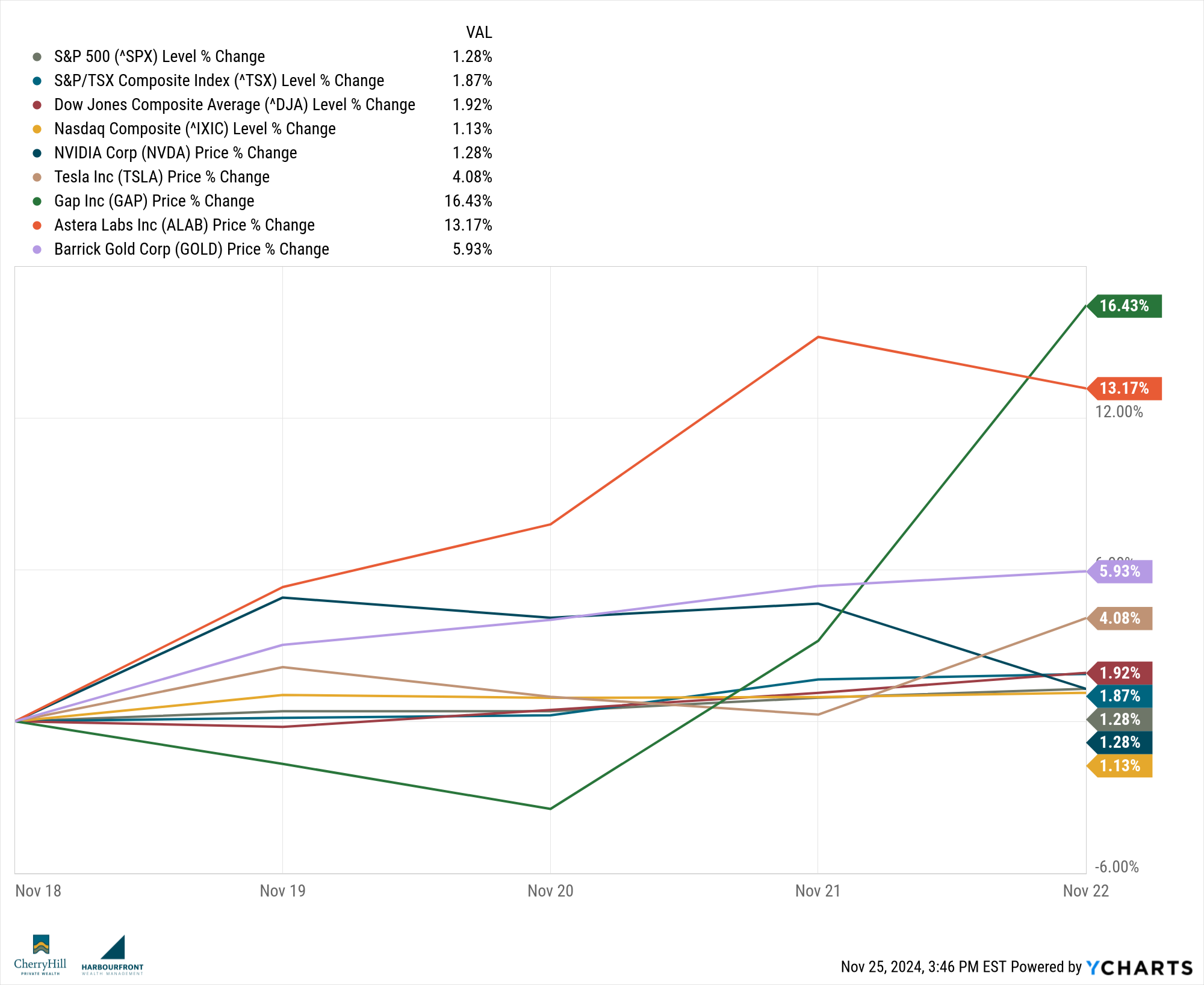
North of the border, the S&P/TSX Composite Index also reached new highs, closing at 25,391 on November 21, marking its fourth consecutive day of gains. Energy stocks were the standout performers, with companies like TransAlta and Vermilion Energy posting increases of over 5.5%, driven by rising oil and natural gas prices. The technology and industrial sectors also contributed to the index’s strength. Commodity prices, particularly for gold, oil, and natural gas, provided a strong tailwind for the Canadian market.
Both markets are clearly benefiting from a combination of strong earnings, supportive commodity prices, and growing investor confidence. It’s an encouraging start to the last quarter of the year, and we’ll continue to monitor how these trends develop in the coming weeks.
The Lighter Side
One of my favourite spectator events is Black Friday. I don’t spend much time on YouTube, but, wow, do I love watching the chaos that ensues when you can save a buck for something you probably didn’t need.
Here are a couple fun facts about Black Friday that you might not have known.

- People Have Camped Out for Days: Die-hard shoppers have been known to set up tents outside stores weeks in advance. In some cases, people spent Thanksgiving dinner in lawn chairs just to snag a $99 TV. Commitment? Or insanity?
- *Fights Over… Towels?: *In 2012, a video went viral of a Walmart brawl. What sparked the chaos? Discounted bath towels for $1.28. Yes, people threw punches over towels.It Once Shut Down a City: In 2011, a mall in Buffalo, NY, had to shut down temporarily when over 15,000 shoppers flooded the parking lot and entrances, causing gridlock that stretched for miles.
- *The Pepper Spray Incident: *During a 2011 Black Friday sale in California, one woman famously pepper-sprayed her fellow shoppers to get ahead in line. Her prize? A discounted Xbox. She escaped before the cops arrived—likely the only “Black Friday Ninja” in history.
- *Weird Items Get Snapped Up Too: *While most people fight for TVs and gadgets, retailers report bizarre Black Friday best-sellers like bulk mayonnaise, leopard-print Snuggies, and life-sized garden gnomes. Apparently, there’s a deal for everyone.
However you choose to spend your Black Friday, I hope your shopping experience is less… chaotic.
The CHPW Team
A lot of conversations about “retirement” have evolved from stopping working to finding a new passion. We got to speak with Lisa Drew, who spent over 30 years in radio before following her passion and starting her own business.
We ask all the questions about starting a business in retirement and dive deep into all the wins and losses that she’s experienced.
Transitioning out of one career and starting a new business is not easy to begin with, but at retirement time - well, we find out how much of a challenge it can be (spoiler: she absolutely loves it).
The retirement years are no longer just about getting as many rounds of golf in as possible, but about chasing passions and finding fulfillment. Lisa, has definitely found a way to do both and you can check out the whole conversation here.

As for the CHPW team, we’re up at Blue Mountain for our annual business planning trip from November 26-28. We will be taking some breaks during our meeting to return emails and reach out to any important matters, but may be a bit slower that you’re used to in getting back to you. We look forward to connecting again when we’re back, recharged and full of new ideas on how to best serve you and your family’s financial needs.
Until next time, stay informed and strategically invested.
Trevor