


The Results are In: What This Means for the Markets & Economy
Has it only been a week?
In today’s email:
- The results are in, so now the questions is: “What does it mean for my investments?”
- Markets appeared to love the election results, but they weren’t all winners.
- There are still several things that we’re keeping an eye on with your investments outside of the election-related movements.
- The CHPW team is starting their year-end planning and would love your feedback!
The Scoop
The U.S. election results are in, and in case you missed it, Donald Trump has emerged victorious. Whether this outcome was anticipated or came as a surprise, it’s vital to assess what his leadership could mean for the economy and investment landscape moving forward. Let’s break down the immediate market reactions, the potential sectors poised for growth, and what this could signal for Canada and asset classes like crypto, private credit, and private equity.
Immediate Market Reactions
Since Trump’s election win, market reactions have been swift and varied. U.S. stock indices initially saw a surge, with sectors aligned with Trump’s pro-business and deregulation policies enjoying an upswing. The Dow Jones Industrial Average and S&P 500 rallied, reflecting optimism in sectors like energy, financials, and industrials. Defensive sectors, including utilities and consumer staples, showed mixed performance as investors shifted focus to growth-oriented opportunities.
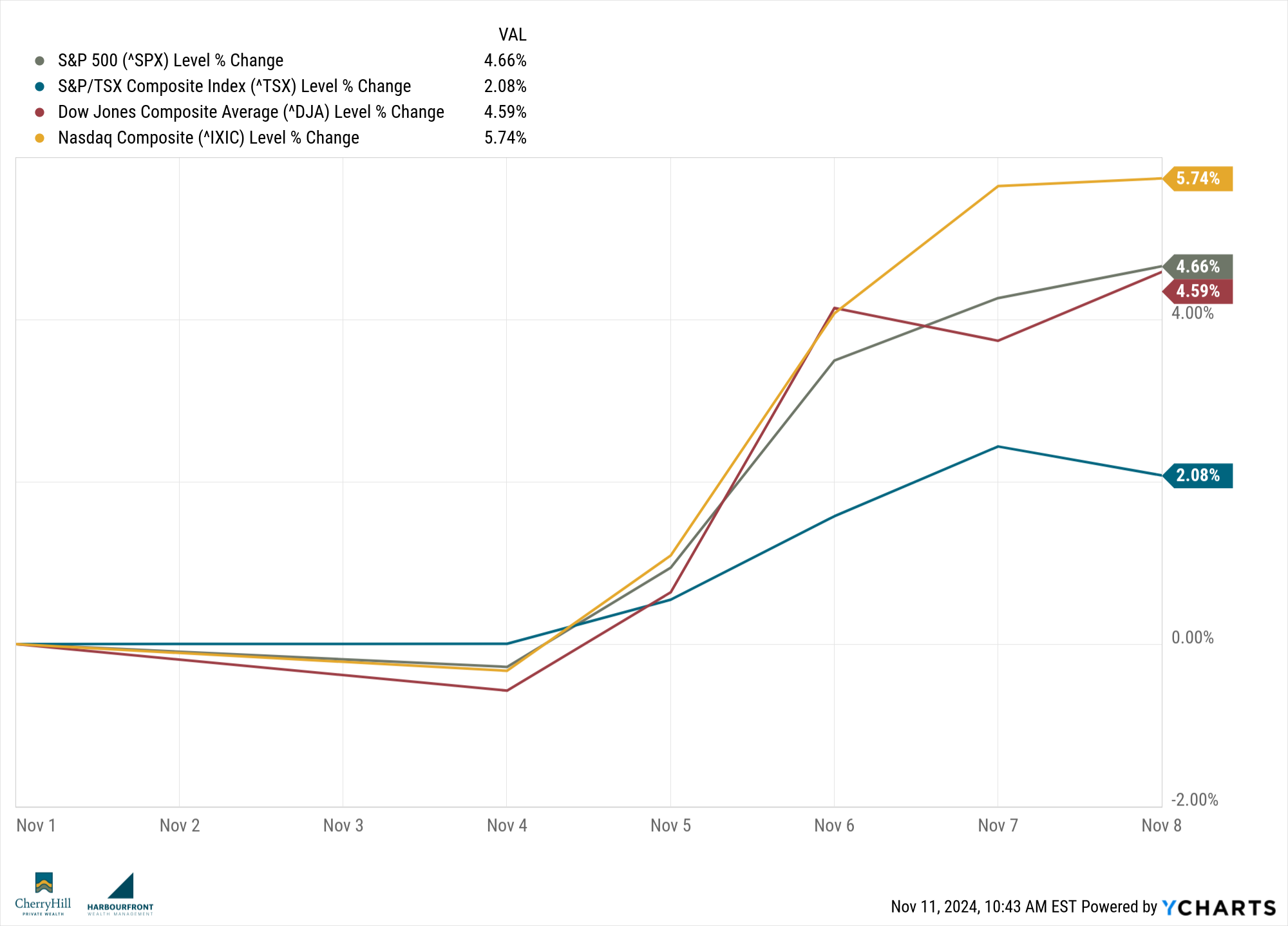
Interest rates saw an uptick, driven by expectations of increased government spending on infrastructure and defence. The bond market adjusted accordingly, with yields rising as investors priced in potential inflationary pressures tied to fiscal stimulus.
Broader Economic Implications
The broader economic sentiment is gearing up for potential policy changes that could redefine trade, taxation, and regulatory landscapes. Trump’s known focus on economic nationalism could usher in changes that influence global supply chains and trade relationships, which brings us to the cross-border effects.
Sectors Poised for Growth
-
Energy and Natural Resources: Trump’s administration is expected to push for greater domestic energy production and reduced regulation. This is welcome news for U.S. oil and gas companies and could translate to increased activity and cross-border trade opportunities for Canadian energy producers.
-
Defence and Aerospace: Military spending is likely to rise, benefiting defence contractors and manufacturers on both sides of the border. Canadian suppliers, especially those integrated into U.S. defence supply chains, could see increased demand.
-
Infrastructure and Industrials: If Trump’s prior focus on rebuilding American infrastructure continues, expect companies in construction, engineering, and materials to benefit. Canadian firms specializing in these sectors might find new partnership opportunities or increased export potential.
What This Means for Canada and the Canadian Dollar
The impact on Canada and the CAD remains complex. On one hand, increased U.S. economic activity may bolster Canadian exports, especially in sectors like energy and manufacturing. On the other hand, more stringent “America First” policies could strain trade relationships or lead to renegotiated trade deals that put Canadian exporters at a disadvantage.
The Canadian dollar (CAD) might respond to these shifts with some volatility. Historically, policies emphasizing U.S. economic strength and independence can put downward pressure on the CAD, especially if paired with higher U.S. interest rates that make the greenback more attractive. However, if Canada aligns itself to benefit from expanded U.S. economic policies—particularly in sectors like energy—these effects could be tempered.
What About Crypto, Private Credit, and Private Equity?
Under a Trump administration, financial policy may continue to lean toward deregulation. This approach could benefit certain financial instruments:
-
Crypto: Cryptocurrency markets might see renewed attention if deregulation efforts extend into the digital assets space. While Trump has expressed skepticism toward crypto, a deregulatory stance could embolden retail and institutional investments as regulatory uncertainties ease. However, investors should stay vigilant—sentiment could shift depending on how the administration navigates the fine line between encouraging innovation and ensuring security. The first movement for this asset class after the Trump victory was robust as anticipation of this deregulation took place.
-
*Private Credit: *The combination of deregulation and pro-business policies could bolster private credit markets. With potentially lower corporate tax rates and eased financial regulations, businesses could seek non-traditional financing avenues for expansion, benefiting funds and family offices active in private credit.
-
Private Equity: PE firms often thrive in environments where tax incentives favour leveraged buyouts and growth initiatives. A Trump-led environment might include tax code adjustments that further encourage investment in growth-oriented companies. This could lead to increased deal flow, higher valuations, and competitive opportunities for those in the private equity space.
What is the “Smart” Money Doing?
Family offices and institutions are already adjusting their strategies. Expect a pivot toward growth sectors that will benefit from a Trump-led economy, including energy, defence, and infrastructure.
Many will likely double down on private equity deals in sectors tied to real assets or industries favoured by Trump’s economic plans. Infrastructure and real estate, especially in regions poised for revitalization projects, may become a focal point. Private credit could see allocation boosts as well, offering returns in a potentially deregulated and business-friendly climate.
Cryptocurrency positions may vary. While some family offices might remain cautious, others could cautiously explore blockchain-related investments if the regulatory environment becomes more navigable.
The Bottom Line
Trump’s election victory sets the stage for a shifting economic and investment landscape, marked by optimism in growth sectors and cautious watchfulness in global trade relations. As we navigate the next few months, staying informed and adaptive will be key to leveraging these shifts to bolster investment strategies.
Market Minute
The past week has been a whirlwind for the markets, with the U.S. presidential election at the forefront. Let’s delve into the key events leading up to the election results, the immediate market reactions, and identify the sectors and stocks that emerged as winners and losers in the aftermath.
Pre-Election Market Movements
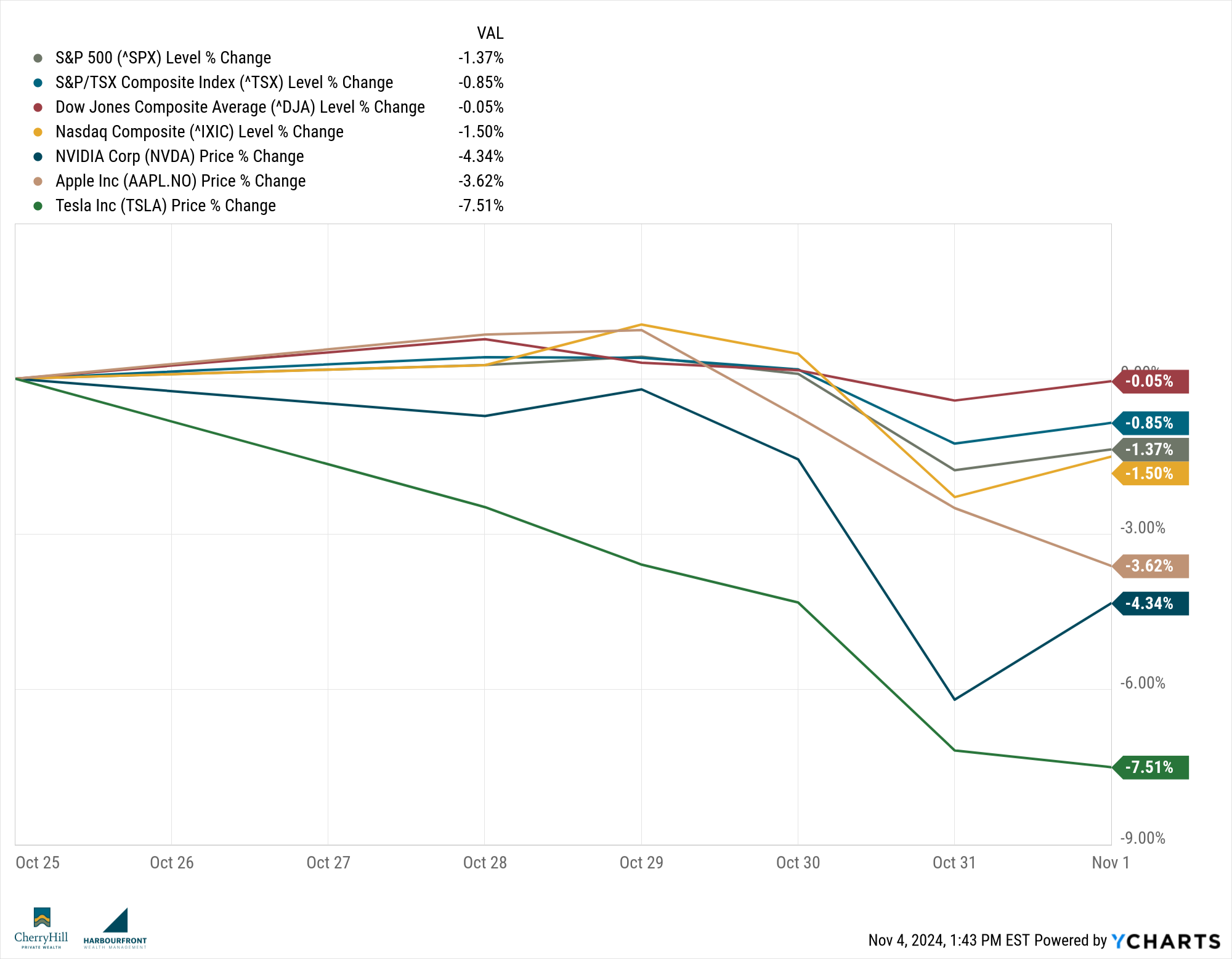
In the days leading up to the election, markets exhibited caution. Investors grappled with the uncertainty of the election outcome, leading to subdued trading volumes and modest fluctuations in major indices. The S&P 500 and Dow Jones Industrial Average experienced slight declines, reflecting the market’s apprehension.
Post-Election Market Reactions
Following the announcement of Donald Trump’s victory, markets responded with notable enthusiasm:
- *Stock Indices Surge: *The Dow Jones Industrial Average surpassed the 44,000 mark for the first time, while the S&P 500 crossed 6,000, both setting new records.
- *Small-Cap Rally: *The Russell 2000 index, representing smaller companies, advanced by over 8%, marking its best week since June 2020.
- *Treasury Yields Climb: *Bond yields, particularly longer-dated ones, rose significantly. The 30-year Treasury yield increased to 4.602%, its largest daily climb in more than a year.
Sector Winners
Several sectors experienced gains in the post-election rally:
- Energy: The Energy Select Sector SPDR Fund (XLE) saw an uptick, reflecting optimism in traditional energy sectors.
- *Financials: *The Financial Select Sector SPDR (XLF) benefited from expectations of deregulation and favourable fiscal policies.
- *Industrials: *The Industrial Select Sector SPDR (XLI) gained, anticipating increased infrastructure spending and economic growth.
Notable Stock Performances
- Tesla: The electric vehicle manufacturer extended its post-election climb, rising 7% and achieving a 28% increase for the week. N
- Nvidia and Sherwin-Williams: Both companies saw their shares rise after being added to the Dow Jones Industrial Average, replacing Intel and Dow Inc.
Sector Losers
While many sectors thrived, some faced challenges:
- Technology: Despite the overall market rally, certain tech stocks lagged, as investors rotated into value and cyclical sectors.
- Utilities and Consumer Staples: These defensive sectors experienced mixed performance, as the market’s risk-on sentiment shifted focus toward growth-oriented industries.
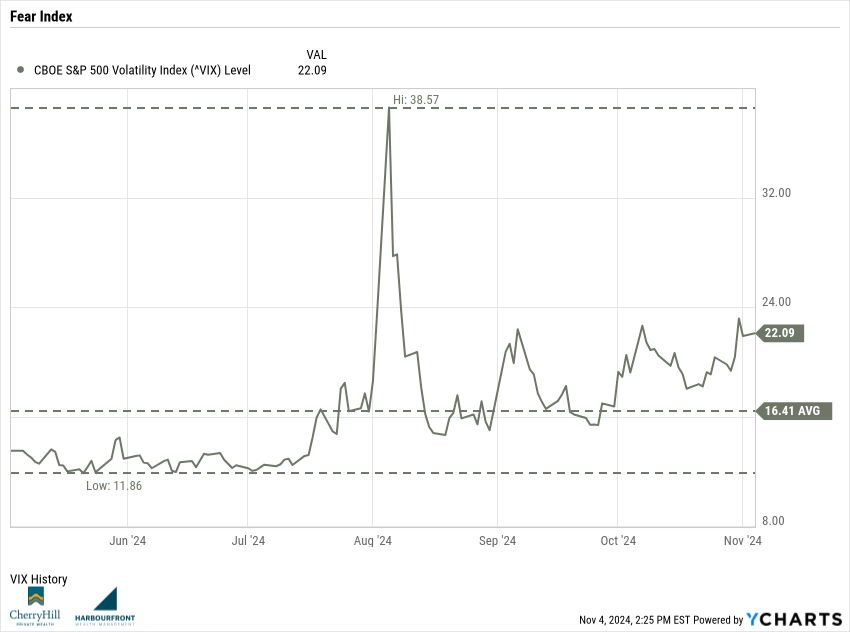
As we look forward past the US election, there are several key trends we’re watching for this week.
- *Post-Election Dynamics: *We saw a quick surge in many markets, especially around energy, financials, and industrials, not to mention Bitcoin hitting a new high. With the dust settling, we will continue to monitor if this initial surge sustains.
- *Bond Market Movements: *Bond yields have risen, with the 10-year treasury yield increasing to 4.47%, indicating investor expectations of higher inflation and potential rate hikes.
- *Corporate Earnings Reports: *Earnings season continues, with major companies across various sectors reporting their quarterly results. Investors are closely monitoring these reports for insights into corporate health and future guidance.
- *Federal Reserve Policy: *The Federal Reserve’s recent rate cut has been a focal point, with markets assessing its implications for future monetary policy and economic growth.
The Lighter Side
Yesterday was Remembrance Day and it got me thinking about the poppy and what it symbolizes. I’ve also questioned my etiquette when it comes to wearing the poppy and wanted to know things like when I should start wearing it, when I should take it off. Here is what I found.
History of the Poppy as a Symbol
Many of us Canadians know that the tradition of wearing a poppy as a symbol of remembrance originates from the famous World War I poem In Flanders Fields by Canadian Lieutenant Colonel John McCrae. He wrote the poem after witnessing the sight of red poppies growing over the graves of fallen soldiers in Flanders, a region heavily impacted by the war. The poem’s lines, “In Flanders fields the poppies blow / Between the crosses, row on row,” poignantly captured the resilience and beauty of the poppies, which soon became synonymous with the remembrance of soldiers’ sacrifices.
Inspired by this, American humanitarian Moina Michael started the practice of wearing poppies in honour of those who died in service. The idea spread internationally, and the poppy was adopted by the Royal British Legion in 1921 as a symbol for Remembrance Day.
What the Poppy Signifies
The poppy symbolizes:
- *Remembrance: *A tribute to those who lost their lives in war.
- Resilience: The poppy’s ability to grow in harsh conditions represents hope and renewal even in the face of devastation.
- *Sacrifice: *Red poppies signify the blood shed by soldiers, acting as a powerful reminder of their sacrifices.

When to Wear the Poppy
Traditionally, poppies should be worn starting from the last Friday in October or at the beginning of November. It should be placed on your left side, close to your heart, signifying respect and remembrance.
When to Remove the Poppy
It’s customary to wear the poppy until Remembrance Day, which is November 11th. Some people choose to remove their poppy at the conclusion of Remembrance Day ceremonies, while others keep wearing it throughout the day as a mark of respect. Another tradition is to leave the poppy at a memorial or cenotaph after the ceremony as an act of tribute.
Some choose to wear their poppy until sunset on November 11th or until they participate in a moment of silence at 11:00 a.m., marking the time when the armistice ending World War I was signed.
The CHPW Team
As we approach the final weeks of 2024 (which feels surreal to say), the Cherry Hill team is gearing up for our planning session for 2025. We’ll be offsite together for much of the week of November 25, focused on strategizing how to bring you, our clients, the highest level of financial planning and service in the industry. In the lead-up to that week, we’d love to hear from you - what you appreciated from the team in 2024, areas where we can improve, and how we can best partner with you in 2025 to make it an exceptional year.
Drop us a note - we’d love to hear from you!
Until next time, stay informed and strategically invested.
Trevor