


What Kind of Legacy are You Leaving?
As Halloween approaches, it’s a good reminder that while ghosts and goblins are just make-believe, the haunting reality of not having a solid estate plan in place can be all too real.
In today’s email:
- Are you up for the executor role? Did you actually pick the right person for the job?
- The S&P is continuing its hot run, while Canada is cooling.
- More Northern Light displays could be on the horizon, but why are we getting these amazing displays?
- A new podcast just dropped and it might be the most important listen you do this year!
The Scoop
On Thursday, our podcast guest was an estate trustee, who discussed all things estate planning, which got me thinking about this important topic (you can check out the conversation here).
This week, I want to focus on a topic that comes up frequently in estate planning discussions but is often underestimated: the role of an executor. If you’ve ever been named as one, or are thinking about who to appoint in your own estate plan, it’s crucial to understand the responsibilities and challenges involved.
What Does an Executor Do?
In simple terms, an executor is the person responsible for managing and settling an estate according to the will. It sounds straightforward, but the role is far from easy. There are over 150 tasks that an executor is responsible for and this can be a pretty time-consuming responsibility.
The first thing an executor has to do is locate and safeguard all assets. This is everything from real estate and bank accounts to belongings and investments. They are also responsible for notifying all beneficiaries about the estate and entitlements. This should be pretty simple, but many times there are little surprises in the will that beneficiaries weren’t expecting.
Next, they have to make sure all debts and taxes are paid. There will be a final tax return that is required and this can be quite complex in some situations depending on the estate’s assets and income sources. Once all the debts are settled, probate has closed, and all the taxes are paid, the executor is responsible for distributing the assets. This can be fairly straightforward, but can also be extremely time consuming, especially if the will is contested or complications arise with the beneficiaries.

Pitfalls to Watch Out For
The role of an executor is an important one, but it’s also fraught with potential pitfalls. This list can be long, but here are the three that I believe to be the biggest.
Time Commitment
This is not a quick task. As Andrea Love comments in our podcast, it’s not like what we see in the movies. We don’t all gather in lawyer’s office, rich in mahogany, where they roll in an old TV with a VHS as the deceased reads out their will and the assets are distributed. There are hundreds of tasks that have to be completed, and that is for an “easy” estate. I don’t know about you, but my life is already pretty busy. Adding another huge job is going to be a challenge for most people that are already juggling family, work, hobbies, and other commitments that already exist.
Personal Liability
Executors can be held personally liable if they make any mistakes such as failing to pay debts or taxes before distributing assets. Even an honest mistake can lead to legal consequences, especially if beneficiaries feel their assets were not adequately protected.
Family Dynamics
Emotions run high when a loved one passes, and executors might find themselves in the middle of a dispute among family members. This can be extremely difficult if the executor is also a family member or close friend. When emotions are high already, delays or perceived inequalities can be taken very personally. If you were expecting the porcelain cow collection, but Aunt Beatrice received it instead, the executor could be the one who gets the brunt of the anger. Many times the beneficiaries are expecting a swift resolution, but it could take several months to several years to close an estate - blaming the executor often happens when delays occur.
Your Emotions
So, you’ve just lost someone you really care about and instead of being able to reflect and grieve, you now have to take care of the executor role. It has historically been considered an honour to be an executor, but the complexity of the role doesn’t leave much time to deal with your emotions. Personally, if something happened to my spouse or parents, the last thing I’d want to do is have to worry about taxes or closing out accounts, etc. This should be a time to share stories and remember the loved one you just lost.

Alternatives to Appointing Family or Friends
Given the complexity and potential for stress, it’s not surprising that many people think twice about appointing a family member or friend as executor. Hiring a professional executor was once left for the “ultra wealth”, but has now become a more normalized process. There are a couple options that are available if you decide that your eldest child or that “friend who is good with numbers” might not be the best fit.
Co-Executors
So, you’re not ready to hire a professional company to handle your affairs once you’re gone. Delegating co-executors can have your loved ones sharing the role and easing the overall burden. This also has the potential to cause issues if the team you pick aren’t able to work together efficiently.
Co-executors can also be in the form of a loved one and a professional firm. This will allow some control for the family member or friend, but with the assistance of a professional. It could be a great balance between the efficiency of a professional firm and the emotional connection of your chosen person.
Professional Executors
More people are looking to professional executors to handle their estate when they’re gone. There is, of course, a cost that comes with this, but it can allow your family and friends to focus on grieving and sharing great memories about you as opposed to dealing with your taxes, debts, distribution of assets, etc. You may also have a better chance of having your wishes carried out exactly as you want since the professionals don’t have the emotional strings attached to the decisions. Many people still refuse to have “the talk” with their family and many things in the will can be left to interpretation. Some people find it easier to have that conversation with the professionals who are experts and are able to ask the right questions to really figure out what your desires are.
On the same vein as the professional executors, there are corporate trustees. Those that have significant assets or business interests should consider this avenue. This can also be very true for those that are caring for a family member who is going to need on-going care.
Final Thoughts
Being an executor is a significant responsibility, and it’s important for anyone named in this role to understand what they’re signing up for. If you’ve been appointed or are considering who to name in your own estate, it might be worth consulting with a professional to understand all your options. And remember, planning now can prevent major headaches down the road.
As always, if you have any questions about estate planning or would like to discuss this further, don’t hesitate to reach out. We’re here to help ensure you and your loved ones are prepared for whatever the future holds.
Market Minute
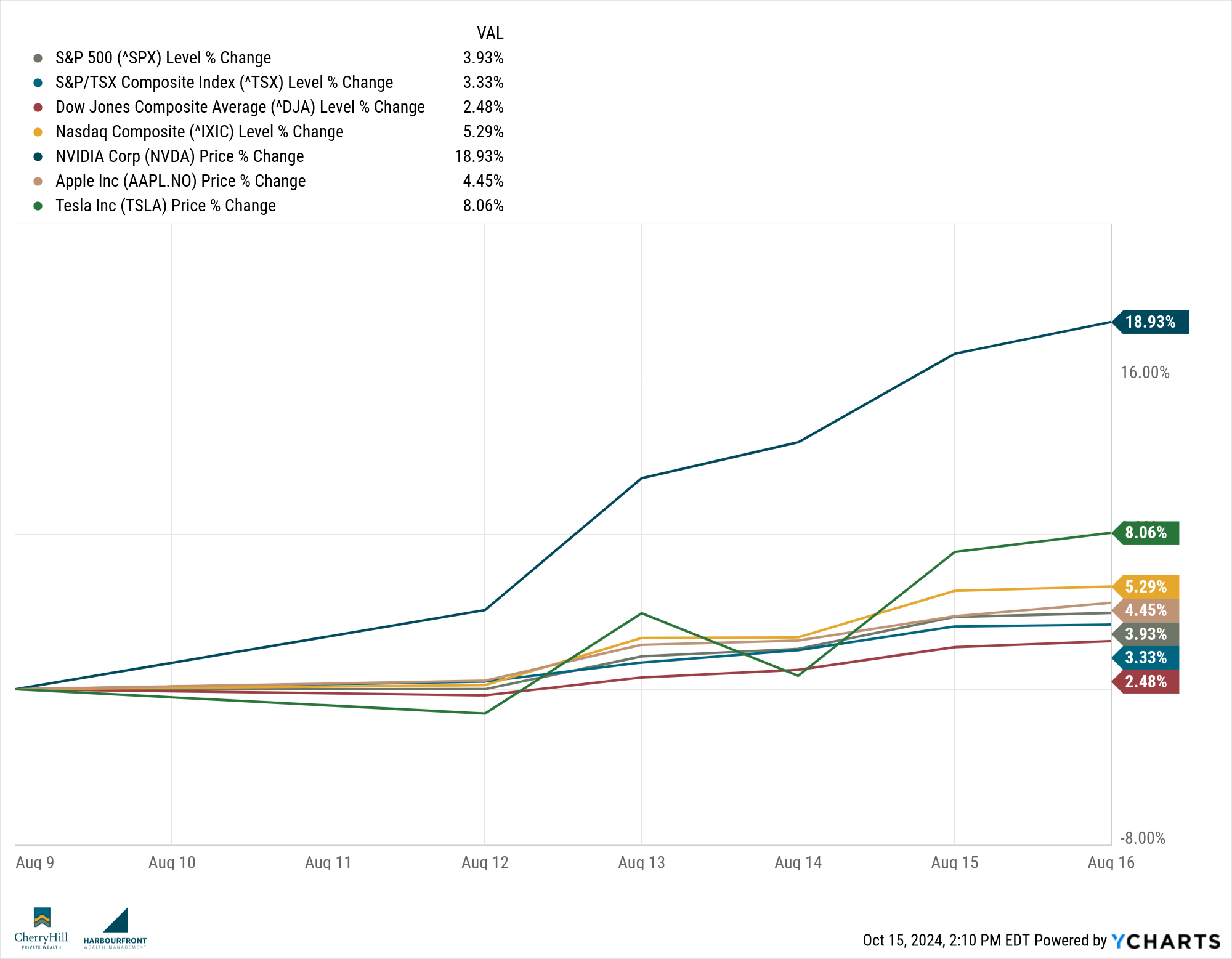
Last week, both the Canadian and U.S. markets saw notable movements with mixed results across different sectors.
In the U.S., the S&P 500 closed the week up 1.4%, buoyed by strong earnings reports from major financial institutions. Technology and consumer discretionary stocks were among the top performers, while energy and utilities sectors lagged. Despite rising bond yields and mixed inflation data, the market showed resilience, thanks to solid corporate earnings and economic strength. Notably, electronic technology and distribution services stocks led the charge, while oil prices also rose 2% due to geopolitical tensions and weather-related disruptions .
In Canada, the TSX was more muted, closing slightly lower earlier in the week due to weaker commodity prices, particularly in energy and materials. This was largely driven by disappointing news from China, which failed to deliver expected stimulus measures. However, as earnings season progresses, investors are paying close attention to financial results, which are likely to influence the market further. Key inflation and employment data from both Canada and the U.S. remain critical drivers in shaping market sentiment
Trends to Watch
- **Earning Season Focus: **Corporate earnings reports are starting to come and investors will be watching the major sectors, particularly technology and financials. Expectations remain high, especially for companies in the S&P 500. As we’ve seen, even when targets are met it could cause unrest from investors since expectations are very high presently.
- **Interest Rates & Inflation: **Following the Fed’s recent rate cut, optimism is growing for a “soft landing”. Inflation remains a key concern with core inflation remaining sticky in the US.
- Geopolitical & Political Risks: Volatility could increase as the US approaches its presidential election, adding a layer of uncertainty to the markets. Additionally, geopolitical tensions, such as in the Middle East, are affecting oil prices and energy stocks, which may continue to experience short-term volatility.
Overall, earnings reports and labour market data will dominate the focus, while interest rate policy and inflation continue to drive broader market sentiment. Investors should prepare for potential volatility as these factors play out.
The Lighter Side
Instagram and social media exploded last week with the incredible display of Northern Lights seen across the country and into the US.
Wonder why this happened at this magnitude?
The recent breathtaking northern lights display was driven by heightened solar activity, specifically a significant coronal mass ejection (CME) from the Sun. A CME occurs when the Sun releases a massive burst of solar wind and magnetic fields from its outer layer, the corona. These charged particles travel through space and, upon reaching Earth, interact with our planet’s magnetic field, causing geomagnetic storms.
When these solar particles collide with gases in Earth’s atmosphere—like oxygen and nitrogen—they excite these atoms, which then release energy in the form of light.

This is what creates the bright colours of the northern lights. The intensity of the recent solar flare was so strong that it allowed the aurora to be visible far beyond its typical range, reaching areas across the U.S. in states like Kentucky and Tennessee, which rarely witness the phenomenon.
Scientists had predicted an uptick in solar activity as part of the 11-year solar cycle, which is currently approaching its solar maximum. During this period, more solar flares and CMEs are expected, meaning we may continue to see auroras in unusual locations in the coming months. The vibrant greens, purples, and reds that were visible last week were a stunning reminder of the connection between our planet and solar activity happening millions of miles away.
This increased solar activity is being closely monitored by space weather experts as it can also have implications for satellite communications and power grids during stronger geomagnetic storms.
The CHPW Team
In this week’s newsletter I touched on estate planning and the role of an executor. Last week we spoke to Andrea Love, President & CEO at Legacy Private Trust to find out everything we could about what the role of an executor entails. We picked her brain on what should be done to leave your estate in the best hands and got an inside scoop on some of the messiest estates she’s seen.
Don’t miss this very important conversation! Check it out here.
Until next week, happy investing!
Trevor